Crude Oil Price by oil-price.net

Oil and Gas Energy News Update

Showing posts with label systems. Show all posts

Wednesday, August 31, 2011

Cameron to Acquire LeTourneau Technologies Drilling Systems

- Cameron to Acquire LeTourneau Technologies Drilling Systems

Wednesday, August 31, 2011
Cameron

Cameron has agreed to acquire LeTourneau Technologies Drillings Systems and Offshore Products divisions from Joy Global for approximately $375 million in cash. The boards of Cameron and Joy Global Inc. have unanimously approved the transaction, which is subject to customary closing conditions. Closing is scheduled during the 4th quarter of 2011.

LeTourneau is a well established provider of drilling equipment and rig designs and components for both the land and offshore rig markets. LeTourneau's products include elevating systems, skidding systems, cranes, top drives, rotary tables, draw works, mud pumps and rig control and power systems.

"The addition of LeTourneau's portfolio of drilling equipment and rig components adds to our existing products offering and enhances the growth opportunities for our drilling systems platform", said Jack Moore, Chairman and CEO of Cameron. "We welcome the LeTourneau team to the Cameron family and look forward to providing our customers and theirs with a greater suite of products and services." Moore further stated that this acquisition is expected to be accretive to Cameron's 2012 earnings.

Credit Suisse Securities (USA) LLC advised Cameron in connection with the transaction. Porter Hedges LLP are serving as legal advisor.

Oil & Gas Post

Promote Your Page Too
LINK

Friday, August 26, 2011

NES Buys FairfieldNodal Cable-Free Systems for Apache's Cook Inlet Proj.

- NES Buys FairfieldNodal Cable-Free Systems for Apache's Cook Inlet Proj.

Friday, August 26, 2011
FairfieldNodal

FairfieldNodal recently completed a significant sale of its true cable-free nodal recording systems to NES, LLC, on behalf of Apache Corporation. The $30 million transaction, which includes ZLand and Z700 marine nodes, represents several industry firsts: the first use of Z700 marine nodes in the United States and the first major use of Z700 and ZLand together in a complementary operation.

NES will use these systems for Apache's extensive 3D land, marine and transition-zone seismic acquisition project in Cook Inlet, Alaska, where unpredictable ice and ground conditions as well as strict governmental requirements present some of the most difficult environmental challenges in North America. They expect the project to continue for up to three years.

"We're very excited about Apache's decision," said Gary Bartlett, FairfieldNodal's regional sales manager for North America. "We recently performed a rigorous 10-day test survey for them in the same area, using our ZLand and Z700 nodes in combination. To have Apache specify our nodes for such a difficult and important project shows how confident they are that our cable-free systems are up to the task."

Because all FairfieldNodal nodes are entirely self-contained, they are easier and faster to deploy and retrieve. In the Apache test survey, they performed flawlessly in the same onshore and shallow-water regions NES will tackle in their upcoming long-term project for Apache.

Oil & Gas Post

Promote Your Page Too
LINK

Thursday, August 11, 2011

GM Confirms A123 Systems Awarded Contract For Future Batteries

- GM Confirms A123 Systems Awarded Contract For Future Batteries


Aug 11, 2011

GM (NYSE:GM) announced today that the company has awarded a production contract to A123 Systems (NASDAQ:AONE) for batteries to be used in future GM electric vehicles to be sold in global markets.

Micky Bly, an executive director at GM said, "GM is committed to offering a full line of electrified vehicles - each of which calls for different battery specifications. We work with a variety of battery developers and A123's advanced Nanophosphate lithium ion technology offers ideal performance capabilities for a future electrified vehicle application."

The specific vehicles and brands will be announced at a later date.

This contract win is being attributed as a driver of A123's stock move, with shares up about 42% so far today.

Oil & Gas Post

Promote Your Page Too
LINK

Wednesday, August 3, 2011

Record Pace Seen for Floating Production Systems

- Record Pace Seen for Floating Production Systems

Wednesday, August 03, 2011
Rigzone Staff
by Karen Boman

Growth in world oil demand, strong oil prices and concerns over supply disruption are among the factors driving growth in the floating production market, according to a recent report by the International Maritime Associates (IMA).

Fourteen floating production units have been ordered over the past four months - including the world's first floating liquefied natural gas (FLNG) vessel – a record pace reflecting strong underlying market drivers, according to IMA. The 1.5 percent to two percent growth in global oil demand per year means that new sources of oil supply need to be developed. To develop these resources, oil and gas companies are increasing their deepwater exploration and production spending.


Jim McCaul, head of IMA, said, "Few if any business sectors can match the dynamism, growth predictability and investment attractiveness of the floating production market."

At $3 billion, the Prelude FLNG is the most expensive floating production unit ordered to date. Other orders include nine floating production storage offloading vessels (FPSOs) - including one purpose-built unit, six units converted from trading tanker hulls and two modification/redeployments - two production spars and two purpose-built floating storage regasification units (FSRUs). Total value of the 14 construction contracts exceeds $11 billion.

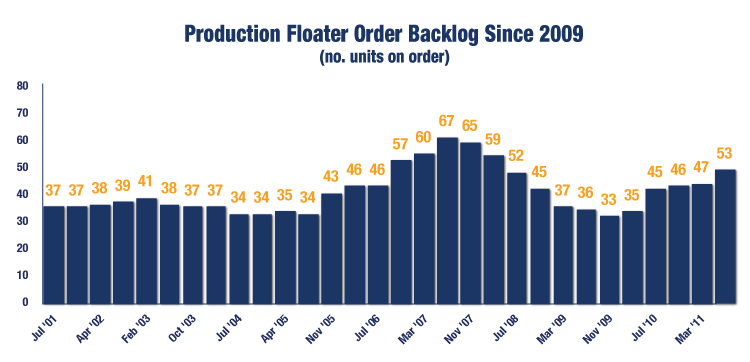
Current order backlog consists of 53 production floaters, a net increase of six units since March. This extends the buildup in backlog that began in the second half of 2009. Twenty-eight units utilize purpose-built hulls, 25 are based on converted tanker hulls. Twenty units are being built for leasing operators, 33 directly for field operators.

In the report, IMA identifies 196 projects in the bidding, design or planning stage that potentially require a floating production or storage system. These projects are declared discoveries or planned develop where a floating production or storage system is being considered as the development option.

Of the 196 planned projects, 53 are in the bidding or final design stage. Major hardware contracts for these projects are likely to be awarded within the next 12 to 18 months. Another 143 floating projects are in the planning or study phase. Major hardware contracts for these projects are likely in the 2013 to 2018 timeframe.

Brazil is the most active region for future projects, with 50 potential floater projects in the planning cycle. Southeast Asia is second with 37 projects, followed by West Africa with 36 projects, Northern Europe with 22 projects, Gulf of Mexico with 17 projects and Australia with 11 projects.

Currently, 256 floating production systems are in service or available worldwide; FPSOs comprise 62 percent of this inventory. The balance of the fleet is comprised of production semis with 17 percent; nine percent is tension leg platforms; seven percent is production spars; and five percent is production barges and FSRUs. Of the total production floater inventory, 11 units are currently off field and available for reuse – making the effective utilization rate of 95.7 percent.

Oil & Gas Post

Promote Your Page Too
LINK

Thursday, June 16, 2011

Parker EPD Unveils Subsea Metrology Systems in GOM

- Parker EPD Unveils Subsea Metrology Systems in GOM

Thursday, June 16, 2011
Parker Hannifin Corp.

Parker Energy Products Division (EPD), a division of Parker Hannifin Corporation, is introducing their subsea metrology and dimensional control services to the Gulf of Mexico oil and gas market.

EPD has demonstrated their success with photogrammetry, surveying and position monitoring services in Northern Europe and Asia Pacific. Recently the division has added technical staff in Houston, Texas to support the metrology service expansion to the Gulf of Mexico.

The first subsea metrology system Parker will utilize in this market is SICAMS®; a single camera metrology system used to obtain accurate subsea measurements (centerline distances, diameters, pitch and roll) of existing structures. With SICAMS®, data can be gathered simply, efficiently, and precisely. Unlike other metrology systems, SICAMS® is revolutionary because it does not require acoustics or a full survey crew. Achieving an accuracy of 1 part in 5,000 is routine with Parker's system, though higher accuracies have been measured. Its state-of-the-art processing capability promises quick calculation and deliverables on-site.

Kristoffer Amdal, Parker EPD's Maritime Business Unit Manager, said, "We are confident that the Gulf of Mexico market will benefit from our metrology services. Accurate dimensional information delivered this fast will definitely prove to be a valuable asset to whatever project our clients need measured, whether it be planning a tooling interface, designing a salvage lift, analyzing physical damage, or even designing retro-fit supports."

The metrology system operates by using multiple photos from many angles to produce an accurate 3D model of the object being measured. In addition, there is a reporting tool built into the processing software which allows for a clearer image to be produced and utilized, therefore providing a more reliable 3D model.

Oil & Gas Post

Promote Your Page Too

Thursday, May 26, 2011

Aker to Supply Offloading Systems in Brazil

- Aker to Supply Offloading Systems in Brazil

Thursday, May 26, 2011
Aker Solutions

Aker Solutions has won two similar contracts, together worth approx. 120 million NOK, from CQG Oil & Gas Contractors Inc. and CCI Oil & Gas Contractors Inc., for the supply of Pusnes offloading systems (TM) to two FPSOs in the Brazilian market.

The offloading systems will be installed on the two FPSOs P-58 and P-62, which are being converted and built for Petrobras.

The two FPSOs are spread moored FPSOs, and will use the field proven Pusnes offloading system (TM) at both bow and aft ends. These offloading systems include tanker mooring and crude oil transfer components as well as emergency offloading stations. Crude oil from the FPSOs will be loaded on to dedicated dynamic positioned shuttle tankers. Aker Solutions last year secured the mooring contracts for the same FPSOs.

The Pusnes offloading system (TM) is recognized by the industry for having established an environmentally responsible, safe and secure connection from the FPSO via a crude oil hose to the dynamic positioned shuttle tanker's bow loading system. In the event of an emergency, the oil flow can be quickly stopped and the vessels disconnected rapidly and safely.

"Aker Solutions' mooring and loading systems have attained a unique position in Brazil. We have signed more than a dozen contracts for various clients in Brazil," said Leif Haukom, head of Aker Solutions' mooring and loading systems business.

As previously communicated, Aker Solutions is also supplying Pusnes mooring systems (TM) to P-58 and P-62, under the terms of a contract with Petrobras.

Delivery of the offshore loading systems to P-58 and P-62 FPSOs will take place in 2011/2012. The contract party for Aker Solutions is Aker Pusnes AS.

Oil & Gas Post

Promote Your Page Too

Monday, May 9, 2011

EFC Reports US Order Growth

EFC Reports US Order Growth

Monday, May 09, 2011
EFC Group

Headquartered in Aberdeen, Scotland, EFC Group announced significant order growth for its Houston office and US-based manufacturing capabilities.

The Americas region of EFC Group, a leading designer and manufacturer of Handling, Control, Instrumentation, and Monitoring Systems for the global oil and gas industry, also announced several major new US contracts, taking its Hydraulic Controls Division over the $1 million USD [approx GBP600,000] mark in 2011 to date.

EFC Group general manager Americas, Mike Coady said: "Our Houston-based staff and contractor numbers have doubled in the last six months to meet local manufacturing demand.

"With the launch of EFC Group Hydraulic Control and Test Panel product line, the Americas team has recently secured contracts totaling over $1million USD. Most notably a contract award for six trailer mounted systems for a global pressure control company."

Ocean Rig has placed a further significant contract for its four ultra-deep waters high-specification drill ships, 12 hotline test panels have been procured, the first three have been delivered onboard the Ocean Corcovado.

Terry Wise, Ocean Rig Subsea Project Engineer commented "EFC quickly customized a neat solution providing the exact regulated lines for our testing needs. We will continue to work with EFC for future control and instrumentation systems."

EFC is predicting 60% international growth over the next two years, with a strong focus on the US market.

EFC showcased its latest hydraulic product launch, the high pressure 15Kpsi BOP Test unit during its OTC Open House. The BOP Test Unit answers the increasing industry need for frequent testing whilst reducing operational downtime.

Mike continues: "With North and South America and Gulf of Mexico sectors accounting for more than 30% of our international business, the US market is extremely important to us and is supported by our growing Houston team. We are continuing to develop our reputation as a specialist supplier of tailored mechnanical handling, well control, BOP control and marine instrumentation system solutions to the global oil and gas industry."

Oil & Gas Post

Promote Your Page Too

Monday, May 2, 2011

Fugro to Acquire JDR Cable Systems

Fugro to Acquire JDR Cable Systems

Monday, May 02, 2011
Fugro N.V.

Fugro has reached agreement with JDR Cable Systems (Netherlands) Ltd to acquire JDR Cable Systems Holdings Netherlands BV and its marine cable subsidiary JDR Cable Systems BV, together comprising JDR's Marine Cables division.

JDR Marine Cables designs and produces special marine cables for oil and gas (subsea lead-in cables, array cables, control cables), geophysical (airgun umbilicals, lead-ins) and defense (towed arrays) market segments. The facility is based close to Rotterdam in the Netherlands, and the division has around 110 employees. The division will operate as an independent unit and aims to further develop its current range of products and services and to continue the supply to all its clients.

Current annual revenues of the company are in the order of Euro 25 million. The division will be renamed to De Regt Marine Cables.

Oil & Gas Post | Promote Your Page Too

Wednesday, April 20, 2011

Deepwater Horizon Spurs Development of Spill Prevention Systems

Deepwater Horizon Spurs Development of Spill Prevention Systems

Wednesday, April 20, 2011
Rigzone Staff

The Deepwater Horizon oil spill disaster in April 2010 prompted the creation of oil spill response systems for use in the Gulf of Mexico and in the North Sea. Two oil spill prevention systems are now available for oil and gas producers in the Gulf of Mexico, and a well capping device is currently under construction in the UK that will be used as part of the UK oil and gas industry's oil spill response efforts.

Helix Well Containment Group

The Helix Well Containment Group (HWCG) plans to conduct a third tabletop exercise in late May to increase its members' coordination and preparedness for a subsea well containment incident. The group already has conducted two tabletop exercises this spring. The most recent exercise in late March brought together more than 225 technical professionals from the oil and gas industry.

HWCC has signed an agreement with Helix Energy Solutions Group, which will provide primary components of the well containment response system. The Helix Fast Response System (HFRS), which has been developed using Helix Energy Solutions Group assets that were deployed in the Deepwater Horizon incident, is expected to be fully operational for water depths of up to 10,000 feet by this summer.

Twenty-three deepwater Gulf operators comprise the HWCG consortium; these operators represent two-thirds of the deepwater operators in the Gulf of Mexico and approximately half of all deepwater oil and gas production in the Gulf. Members include Anadarko Petroleum Corp.; Apache Corp.; ATP Oil & Gas; BHP Billiton; Cobalt International Energy; Deep Gulf Energy; Eni; Energy Resource Technology GOM; Hess Corp.; LLOG Exploration Company; Marathon Oil Company; Marubeni Oil & Gas; Murphy Exploration & Production; Newfield Exploration Company; Nexen Petroleum; Noble Energy; Plains Exploration & Production; Repsol E&P USA; Statoil; Stone Energy; Walter Oil & Gas Corporation; Woodside Energy; and W&T Offshore.

Marine Well Containment Company

The Marine Well Containment Company (MWCC) in February launched its interim rapid response system to capture and contain oil from potential underwater well blowouts in the deepwater Gulf. The system can operate in up to 8,000 feet of water and process up to 60,000 b/d of fluid. Work is underway to expand the system to operate in up to 10,000 feet of water and process up to 100,000 b/d, with components to be delivered in 2012.

Capping Stack, Marine Well Containment Co.
ExxonMobil, ConocoPhillips and Chevron announced the plan to build and develop the system last July; since then, BP, Anadarko Petroleum Corp., Apache Corp., BHP Billiton, Shell, Hess Corp. and Statoil have joined MWCC. These 10 companies operated approximately 70 percent of deepwater wells drilled in the U.S. Gulf of Mexico between 2007 through 2009. The non-profit, stand-alone organization is open to all companies operating in the U.S. Gulf of Mexico.


Cooperation, Encouragement of Innovation Needed

The private sector worked hand in glove with the U.S. Coast Guard's research and development division and U.S. Navy research centers to assess technology, particularly for surface containment applications, said Owen Kratz, Helix president and chief executive officer, while testifying before Congress on April 4. "The NOAA also had tremendous value to bring to bear," said Kratz. "We certainly encourage those government agencies to work closely with industry organizations like the HWCG and Marine Well Containment Corporation established by some of the major integrated oil companies."

Helix used the lessons it learned from its participation in containing the Deepwater Horizon oil spill to its approach to containment efforts in the future. While coordinating and idea sharing is very important to making advances, Kratz noted that the U.S. government can assist the industry by minimizing the cost of capital by reinvigorating programs specifically designed to advance maritime industrial development. A familiar program of this type is the U.S. Maritime Administration (MARAD)'s loan guarantee program. Kratz said MARAD could help responsibly and within fiscal constraints, and has a "proven track record for bringing innovative vessel designs to market.

"As we have seen, the most innovative vessel designs will be the most useful going forward," Kratz said. The Q4000, built in Texas with MARAD financing, provides an excellent example, and was instrumental in bringing the Macondo blowout under control, Kratz said.

The Q4000 Drilling Platform
Having a diverse array of players in upstream oil and gas has allowed for technological innovation. "When the government fails to respond appropriately to permitting concerns or creates significant doubt which undermines business confidence, it saps potential investment capital necessary to innovate," Kratz said.

UK Well Capping Device

Energy industry association Oil & Gas UK in March confirmed that construction of a well capping device was underway at Cameron Ltd., in Leeds, UK. The capping device will become a key element of the UK offshore oil and gas industry's oil spill response contingency plans. Completion of the device is due this summer.

The cap is modular in design, with specifications that allow it to be deployed in the widest range of possible oil spill scenarios that could typically be encountered in the UK Continental shelf including west of Shetland.

The device has an overall working pressure rating of 15,000 psi, and is capable of capping a well flowing up to 75,000 b/d and in water depths of up to 5,500 feet. Capping should be achieved within 20-30 days of the incident, depending on weather and well site conditions.

LINK 
The Gulf of Mexico Oil Spill
Latest Deepwater Horizon Headlines

Thursday, April 14, 2011

Offshore Officials Get In-Depth Look

Offshore Officials Get In-Depth Look

Thursday, April 14, 2011
Houston Chronicle
by Jennifer A. Dlouhy

The top U.S. officials in charge of offshore oil and gas exploration on Wednesday got a close-up look at the first deep-water drilling project approved since last year's oil spill.

Interior Secretary Ken Salazar and his chief offshore regulator, Michael Bromwich, spent two hours examining new safety systems -- including one spurred by the spill -- on the Ensco 8501 rig that is about to begin drilling a bypass well for Noble Energy in the Gulf of Mexico.

They touched drilling fluids hauled from pits on the semisubmersible rig, interviewed workers about their jobs and studied the systems used as a last line of defense against surging oil and gas.

Afterward, Salazar said he was impressed that "testing capabilities have been significantly enhanced since a year ago."

"We're starting to see the beginning of a significant change in the culture that holds great promise," Salazar added.

Within days, the Ensco 8501 is set to begin drilling the well in Noble Energy's Santiago prospect 70 miles southeast of Venice, La., resuming work that started just four days before the blowout of BP's Macondo well and destruction of the Deepwater Horizon drilling rig last April 20.

Houston-based Noble drilled more than 7,000 feet below the seafloor in 6,500 feet of water before it was forced to plug the well under a moratorium on deep-water drilling that took effect weeks after the Macondo blowout.

The new bypass drilling is meant to get around the plugs in the original well.

Although Noble Energy is the operator of the project, with a 23.25 percent working interest, BP owns 46.5 percent of it. The other partners in the project are Red Willow Offshore and Houston Energy Deepwater Ventures.

Noble Energy secured its permit to resume work at the site on Feb. 28, becoming the first of 10 deep-water projects blocked by last year's ban that now have gotten the green light. So far, drilling has begun on just one: a well in Shell Oil's Cardamom Deep discovery 137 miles off the Louisiana coast.

One hundred twenty-three people now are working at the Noble Energy well, including 78 who work for Ensco and others employed by about a half-dozen other contractors.

Workers on the rig -- built as a collaboration between Ensco and Noble two and a half years ago -- stressed the safety practices onboard. At one point, an Ensco worker reminded Salazar and Bromwich to don protective glasses and earplugs.


Blowout preventer

Inside the drilling shack at the heart of the rig, the two officials pressed workers to answer questions about the blowout preventer designed as a final barrier against loss of well control. A four-month examination of the blowout preventer used at BP's well concluded it was unable to slash through off-center drill pipe, seal the well hole and trap oil underground.

Although blowout preventers are built to shear through drill pipe, they can't cut through thick joints connecting pipe. That means drillers must know whether narrow pipe or joints are passing through the device.


'Give me comfort?'

Salazar wanted to know what would ensure that pipe joints weren't in the way.

"What will give me comfort that in this rig, that will not happen?" he asked.

Don Williamson, the rig manager, stressed that the driller always knows the position of the pipe.

The Hydril blowout preventer being used at the Noble Energy well is two and a half years old -- the same age as the rig itself.

After last year's spill, the government stepped up testing requirements for blowout preventers, including access points called hot stab panels that allow remote controlled vehicles to operate equipment deep beneath the surface.

On the Ensco 8501, that meant installing new equipment from Oceaneering that allows the workers on the surface to conduct quicker, more efficient tests of the hot stab function.

"It's greatly enhanced our ability to test the stabs on the surface," said Rusty Critselous, a drill site leader for Noble Energy. "With this little unit, our hot stab lines are shorter and the testing process is quicker."


'New and better ways'

Bob Bemis, Noble Energy's vice president of environmental, health and safety, said the federal mandate prompted the change.

"That regulation is causing us to develop new and better ways to develop these testing techniques," Bemis said.

Bromwich, director of the Interior Department's Bureau of Ocean Energy Management, Regulation and Enforcement, observed later that it was gratifying that the federal requirements had spurred innovation, but said he would prefer the industry to have its own incentives for safety improvements.

"What's been missing from the industry over the last several decades has been the drive to innovate for safety without new requirements," Bromwich said.

The backdrop for the visit Wednesday was continuing tension between the oil industry and the Obama administration.

Oil industry representatives have complained that the administration is moving too slowly to restart offshore drilling following last year's spill.