Crude Oil Price by oil-price.net

Oil and Gas Energy News Update

Showing posts with label Pace. Show all posts

Wednesday, August 3, 2011

Record Pace Seen for Floating Production Systems

- Record Pace Seen for Floating Production Systems

Wednesday, August 03, 2011
Rigzone Staff
by Karen Boman

Growth in world oil demand, strong oil prices and concerns over supply disruption are among the factors driving growth in the floating production market, according to a recent report by the International Maritime Associates (IMA).

Fourteen floating production units have been ordered over the past four months - including the world's first floating liquefied natural gas (FLNG) vessel – a record pace reflecting strong underlying market drivers, according to IMA. The 1.5 percent to two percent growth in global oil demand per year means that new sources of oil supply need to be developed. To develop these resources, oil and gas companies are increasing their deepwater exploration and production spending.
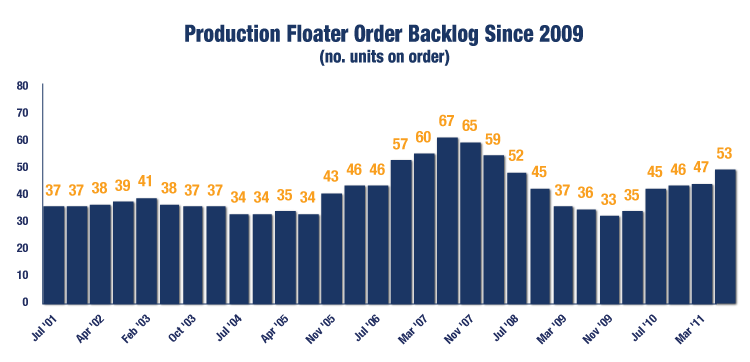


Jim McCaul, head of IMA, said, "Few if any business sectors can match the dynamism, growth predictability and investment attractiveness of the floating production market."

At $3 billion, the Prelude FLNG is the most expensive floating production unit ordered to date. Other orders include nine floating production storage offloading vessels (FPSOs) - including one purpose-built unit, six units converted from trading tanker hulls and two modification/redeployments - two production spars and two purpose-built floating storage regasification units (FSRUs). Total value of the 14 construction contracts exceeds $11 billion.

Current order backlog consists of 53 production floaters, a net increase of six units since March. This extends the buildup in backlog that began in the second half of 2009. Twenty-eight units utilize purpose-built hulls, 25 are based on converted tanker hulls. Twenty units are being built for leasing operators, 33 directly for field operators.

In the report, IMA identifies 196 projects in the bidding, design or planning stage that potentially require a floating production or storage system. These projects are declared discoveries or planned develop where a floating production or storage system is being considered as the development option.

Of the 196 planned projects, 53 are in the bidding or final design stage. Major hardware contracts for these projects are likely to be awarded within the next 12 to 18 months. Another 143 floating projects are in the planning or study phase. Major hardware contracts for these projects are likely in the 2013 to 2018 timeframe.

Brazil is the most active region for future projects, with 50 potential floater projects in the planning cycle. Southeast Asia is second with 37 projects, followed by West Africa with 36 projects, Northern Europe with 22 projects, Gulf of Mexico with 17 projects and Australia with 11 projects.

Currently, 256 floating production systems are in service or available worldwide; FPSOs comprise 62 percent of this inventory. The balance of the fleet is comprised of production semis with 17 percent; nine percent is tension leg platforms; seven percent is production spars; and five percent is production barges and FSRUs. Of the total production floater inventory, 11 units are currently off field and available for reuse – making the effective utilization rate of 95.7 percent.

Oil & Gas Post

Promote Your Page Too
LINK

Monday, May 9, 2011

Cook Inlet Drilling Still Lags Pace Needed to Sustain Gas Supply

Cook Inlet Drilling Still Lags Pace Needed to Sustain Gas Supply

Monday, May 09, 2011
Alaska Journal of Commerce
by Tim Bradner

More drilling is under way in Cook Inlet natural gas fields, but the pace is still short of the number estimated to needed to forestall shortages of gas in the region.

Still, there are glimmers of hope. Although the quantities are still small, new gas is coming into Enstar Natural Gas Co.'s pipeline system from a new producer, Armstrong Oil and Gas.

Also, explorers drilling for gas in Southcentral appear to be finding some, although it is too early to know whether the wells can be commercially produced.

The overall pace still falls short of what is needed.

Firms operating producing fields in Southcentral Alaska this year plan four new production wells. Independent companies also have drilled three exploration wells this winter. The last one, being drilled near the city if Kenai, is now being completed.

However, seven new gas wells in total drilled this year are less than half the 18 new wells estimated to be needed each year if the region's gas reserves are to be sustained.

The estimate was done for the regional utilities in 2010 by Petrotechnical Resource Alaska, an Alaska-based petroleum-consulting firm.

Meanwhile, Southcentral electric utilities have kicked off construction of a number of new gas-fueled power generation facilities, but there are questions about where the gas for these new plants will come from.

Chugach Electric Association and Municipal Light and Power have the new $369 million Southcentral Power Project plan underway in south Anchorage.

Matanuska Electric Association's new $250 million gas-fired generation plant in Eklutna is in the early stages of permitting.

Homer Electric Association also has two new, smaller power generation projects, one that has started construction.

The Regulatory Commission of Alaska has approved Chugach's request to pass its share of the Southcentral power plant costs, about $200 million, on to its customers. A similar request is anticipated from ML&P for its one-third share, RCA chairman Bob Pickett said.

Although the turbines in the new facilities will be more efficient, typically using a third less gas to generate power than older equipment now used, the net result may still be an increase in total gas use.

It isn't clear where the gas will come from. A gas pipeline from the North Slope is years away, if it can even be built. Several utilities, including the regional gas utility, Enstar Natural Gas Co., are working on possible imports of liquefied natural gas.

"There's not much we can say about it right now," Enstar spokesman John Sims said.

Jim Posey, ML&P's general manager, said about the same.

"I'm much more encouraged about this than I was three months or six months ago," Posey said. He said he hopes to be able to talk in more detail sometime in the summer.

Pickett, at the RCA, said the regulatory commission wants to know about this, however.

The commission will ask the utilities to tell it where things stand on possible LNG imports in a meeting in late May or early June, Pickett said.

Although the pace of drilling isn't enough, there are some positive developments for the regional gas supply pictures.

Enstar is now taking delivery of gas from the small North Fork gas field on the Kenai Peninsula near Homer, Enstar said.

Armstrong Oil and Gas, a Denver-based independent company that owns the North Fork field, began deliveries in early April, Enstar spokesman Sims said.

The utility is taking about 15 million to 25 million cubic feet of gas daily, although this is expected to increase. Enstar's contract with Armstrong calls for the company to deliver 1 billion cubic feet of gas per year.

Enstar built a $21 million, 21-mile, eight-inch pipeline from an existing pipeline from Ninilchik to Anchor Point, where it has linked with two four-inch pipelines built by Armstrong from the North Fork field.

Armstrong is now producing from two wells at North Fork and has drilled two more wells, Sims said.

Companies operating producing fields in the region have four new production wells planned. Marathon Oil Co. plans one well in the Ninilchik gas field on the Kenai Peninsula. Marathon also plans two new production wells on the Steelhead platform in Cook Inlet. Marathon owns the platform, which produces gas, although Chevron Corp. manages production operations.

One new production well is planned for the Beluga gas field, according to Municipal Light & Power, which owns a third of the field.

Exploration wells drilled this winter meanwhile have found some gas, although it is too early to know if they can be produced.

Linc Energy, an Australian independent, reported finding gas at its test well drilled in the Matanuska Susitna Borough late last fall, although testing is now under way on possible production.

Nordaq Energy completed an exploration well on the Kenai Peninsula in April, and although results weren't announced the company said it is working on permits for surface facilities, a good sign.

Buccaneer Energy Ltd. is now completing its exploration well, also on the Kenai Peninsula. The well has encountered gas shows but whether these can be produced remains to be seen.

There are also plans for two jack-up rigs to be operating in deeper waters of Cook Inlet this summer. One rig is now being transported to the Inlet by Escopeta Oil and Gas, another independent.

Buccaneer Energy plans to bring a second, larger jack-up rig to the Inlet this summer.

Both companies own leases with prospects that will be tested by the two jack-up rigs.

Oil & Gas Post

Promote Your Page Too