Crude Oil Price by oil-price.net

Oil and Gas Energy News Update

Showing posts with label Seen. Show all posts

Wednesday, August 17, 2011

Sheen Seen Emanating from BP Thunderhorse Platform in US Gulf

- Sheen Seen Emanating from BP Thunderhorse Platform in US Gulf

Wednesday, August 17, 2011
Dow Jones Newswires
HOUSTON
by Ryan Dezember

A band of silvery sheen was spotted emanating from BP's Thunderhorse platform Tuesday in the U.S. Gulf of Mexico, though the company said that it has taken action to prevent further discharges, according to a government filing.

A two-foot-wide band of sheen stretching 30 feet from the platform, which is located in deep water south of the Mississippi-Alabama state line, was reported to the National Response Center on Tuesday.

BP told federal pollution regulators that the unspecified substance came from a discharge pipe and that it was adjusting waste treatment chemicals on the platform to remediate the problem, according to the filing.

A BP spokesman did not immediately respond to a request for comment.

Copyright (c) 2011 Dow Jones & Company, Inc.

Oil & Gas Post

Promote Your Page Too
LINK

Friday, August 5, 2011

Monterey Oil Shale Seen as Next Wave of U.S. E&P Efforts

- Monterey Oil Shale Seen as Next Wave of U.S. E&P Efforts

Friday, August 05, 2011
Rigzone Staff
by Karen Boman

California's Monterey shale oil play could become the next wave of U.S. exploration and production as high oil prices, and the sale of non-core assets by major oil and gas operators, has opened the door for smaller oil and gas companies to pursue the play.

Oil has been produced from the Monterey shale since the early 1900s, but the major oil companies who first explored for oil in California initially focused much of their exploration efforts on the state's heavy oil fields. Drilling wells in the state's heavy oil fields was economic; thus, majors did not have the incentive to explore the deeper Monterey shale with inexpensive oil to develop. The fact that exploration acreage has mostly owned or leased by major oil companies or controlled by government entities meant there was little room for smaller oil and gas companies to enter California.

However, the sale of non-core assets has opened the door for smaller operators to enter the market, and the shift by oil and gas companies towards liquids plays from natural gas due to strong oil prices has prompted companies to pursue emerging oil shale plays.

Early last month, the U.S. Energy Information Administration (EIA) estimated in its report, Review of Emerging Resources: U.S. Shale Gas and Shale Oil Plays, that the Monterey/Santos play in southern California holds 15.4 billion barrels of shale resources; the Bakken and Eagle Ford are the next largest shale oil plays at approximately 3.6 billion barrels and 3.4 billion barrels of oil respectively. The Monterey shale is the primary source rock for the conventional oil reservoirs found in the Santa Maria and San Joaquin basins in southern California.

Besides oil prices and sale of non-core assets by majors, the state government's interest in creating jobs and revenue within California also is helping to create an environment conducive for Monterey shale oil development, said Global Hunter Securities analyst Phil McPherson, adding that the governor has increased funding for the state's Division of Oil, Gas and Geothermal Resources and increased the number of permits issued.

The need to reverse the two decades of declining oil production within the state is driving the need for new oil production to be brought online. Enhanced oil recovery techniques are being used at historic fields such as Kern River and Midway set to maintain production, but with a mature basin, there is only so much that can be done, McPherson said. California, the third largest U.S. oil producing state, produced 555,000 b/d of crude oil in February of this year, EIA reports.

As a result of these factors, McPherson sees significant potential in the Monterey shale, and while drilling results have been mixed to date, McPherson notes that the Barnett shale took 15 years to figure out and the Bakken oil play four to five years before drilling efforts found success. "Companies pursuing the Monterey shale are still learning the science and the lay of the land," McPherson said.

Venoco Inc., which has 14 years experience drilling and producing from the Monterey horizon offshore California with its Sockeye and South Ellwood fields, began leasing Monterey shale formation properties onshore in 2006. Venoco Chairman and CEO Tim Marquez said the EIA's report on the Monterey shale confirms much of what the company has said about the Monterey shale potential.

A massive amount of data is available on the Monterey, which has sourced six of the largest U.S. oil fields, with over 17,000 wells having penetrated the Monterey in Venoco's target basins and over 11,000 of those wells tested or produced from the Monterey. The company also has acquired over 1,100 digital logs, with shale-petrophysical analysis on more than 50 of these wells.

Venoco currently is operating one rig in its Monterey shale play and is working to identify and secure up to four additional rigs by year-end 2011. The increase in rigs would be in anticipation of much greater activity in 2012, when the company currently expects it may run six to eight rigs in the play and spud between 50 and 75 primarily vertical wells, as warranted by drilling and production results. The company anticipates that it will spend $100 million, half of its capital budget, on its Monterey shale assets.

Drilling activity next year would be focused on delineation and development wells in the company's Sevier discovery, in the area covered by the company's 3-D seismic shoot with Occidental Petroleum in the San Joaquin Valley and, after completion of an anticipated 3-D seismic survey, in the Salinas Valley. "We are shoring up our development plans for the Sevier discovery and have been in contact with the agencies to ensure we have a clear path forward to develop this discovery," said Marquez. "We currently expect to drill 30 to 40 wells there next year."

Venoco plans to drill three to four additional delineation wells in its Sevier discovery during the second half of 2011. The company also continues to expand its onshore Monterey acreage position, which includes approximately 304,000 gross and 214,000 net acres across the Santa Maria, Salinas Valley and San Joaquin basins, the latter of which includes the Sevier discovery. Venoco has a number of people searching for acquisition and leasing opportunities to acquire additional acreage interest.

Marquez said Venoco has completed and started testing one zone in its Sevier 1-29 sidetrack well during the second quarter. "Because this is a redrill, we have smaller casing in the well which limits our production volumes and presents a challenge to reducing fluid levels. With this constraint, we are encouraged by the peak 24-hour rate of 61 BOE/d from that initial zone. We have two other zones in this well to test once we're finished testing the initial zone."

Venoco has had to revise some of the initial concepts from its Monterey shale production offshore from the Sockeye field, which has two different zones of Monterey that are shallower and less naturally fractured. The company has concluded that drilling vertical wells is a more economic way to tap the Monterey shale and that comes in contact with more gross intervals of oil, said Mike Edwards, vice president of corporate and investor relations at Venoco. Venoco's wells likely will be produced through acidization, in which acid is sent to recover mud from the natural fractures, rather than hydraulic fracturing.

Venoco's current focus is on its Sevier discovery, but the company also sees potential for horizontal wells in its Santa Maria prospect area. The company has drilled vertical wells with initial production rates of 1,000 b/d, and believes that particular zones of the prospect area hold potential for horizontal wells.

Oil & Gas Post

Promote Your Page Too
LINK

Wednesday, August 3, 2011

Record Pace Seen for Floating Production Systems

- Record Pace Seen for Floating Production Systems

Wednesday, August 03, 2011
Rigzone Staff
by Karen Boman

Growth in world oil demand, strong oil prices and concerns over supply disruption are among the factors driving growth in the floating production market, according to a recent report by the International Maritime Associates (IMA).

Fourteen floating production units have been ordered over the past four months - including the world's first floating liquefied natural gas (FLNG) vessel – a record pace reflecting strong underlying market drivers, according to IMA. The 1.5 percent to two percent growth in global oil demand per year means that new sources of oil supply need to be developed. To develop these resources, oil and gas companies are increasing their deepwater exploration and production spending.


Jim McCaul, head of IMA, said, "Few if any business sectors can match the dynamism, growth predictability and investment attractiveness of the floating production market."

At $3 billion, the Prelude FLNG is the most expensive floating production unit ordered to date. Other orders include nine floating production storage offloading vessels (FPSOs) - including one purpose-built unit, six units converted from trading tanker hulls and two modification/redeployments - two production spars and two purpose-built floating storage regasification units (FSRUs). Total value of the 14 construction contracts exceeds $11 billion.

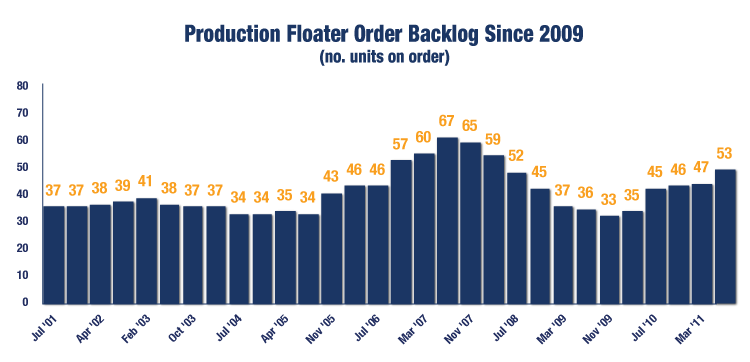
Current order backlog consists of 53 production floaters, a net increase of six units since March. This extends the buildup in backlog that began in the second half of 2009. Twenty-eight units utilize purpose-built hulls, 25 are based on converted tanker hulls. Twenty units are being built for leasing operators, 33 directly for field operators.

In the report, IMA identifies 196 projects in the bidding, design or planning stage that potentially require a floating production or storage system. These projects are declared discoveries or planned develop where a floating production or storage system is being considered as the development option.

Of the 196 planned projects, 53 are in the bidding or final design stage. Major hardware contracts for these projects are likely to be awarded within the next 12 to 18 months. Another 143 floating projects are in the planning or study phase. Major hardware contracts for these projects are likely in the 2013 to 2018 timeframe.

Brazil is the most active region for future projects, with 50 potential floater projects in the planning cycle. Southeast Asia is second with 37 projects, followed by West Africa with 36 projects, Northern Europe with 22 projects, Gulf of Mexico with 17 projects and Australia with 11 projects.

Currently, 256 floating production systems are in service or available worldwide; FPSOs comprise 62 percent of this inventory. The balance of the fleet is comprised of production semis with 17 percent; nine percent is tension leg platforms; seven percent is production spars; and five percent is production barges and FSRUs. Of the total production floater inventory, 11 units are currently off field and available for reuse – making the effective utilization rate of 95.7 percent.

Oil & Gas Post

Promote Your Page Too
LINK
Thursday, July 28, 2011

BP: N Sea Valhall Oil Platform Restart Not Seen Before Mid-Aug

- BP: N Sea Valhall Oil Platform Restart Not Seen Before Mid-Aug

Thursday, July 28, 2011
Dow Jones Newswires
LONDON
by Konstantin Rozhnov

Production at the BP-operated Valhall oil platform in the Norwegian sector of the North Sea is unlikely to resume before mid-August as the company needs to complete a review into a fire at the facility, a BP spokesman said Thursday.

Damage to the platform was modest and caused mostly by water used to spray on the fire, BP spokesman Matt Taylor said.

Copyright (c) 2011 Dow Jones & Company, Inc.

Oil & Gas Post

Promote Your Page Too
LINK

Tuesday, July 5, 2011

Tullow 1H Revenue Seen Boosted By Jubilee, Higher Oil Price

- Tullow 1H Revenue Seen Boosted By Jubilee, Higher Oil Price

Tuesday, July 05, 2011
Dow Jones Newswires
LONDON

Tullow Oil said it expects to post record first-half revenue of $1.05 billion next month, as the London-based explorer continues to ramp up production from its Jubilee field offshore Ghana to 80,000 barrels of crude a day, a 14.3% increase from the level announced last month.

In a trading update, Tullow said first-half working interest production has averaged 75,350 barrels of oil equivalent a day, an 35% increase from the 55,800 boe/day logged in the corresponding period in 2010.

For the full year, Tullow said it expects to produce 90,000 to 94,000 boe/day, more than 50% higher than last year, boosted by new licenses in Ghana and the North Sea acquired earlier this year.

"The performance of our business since the beginning of 2011 has been excellent and we expect to deliver record financial results for the first half of the year," said Chief Executive Aidan Heavey.

Tullow said it expects total first-half revenue of around $1.05 billion, compared with $486 million for the same period in 2010, attributing the sharp rise to higher sales volumes thanks to the contribution of Jubilee, its largest discovery and which is expected to reach plateau production of 120,000 barrels a day in August.

The company's anticipated surge in revenue has also been underpinned by "significantly higher" oil and gas prices, the company said, adding that its oil production sold at an average discount of approximately 2% to Brent during the first half of 2011.

Analysts said while the trading update didn't contain any surprises, it did confirm Tullow's growth program remains on track.

Angus McPhail said it was further evidence "that Tullow is graduating from E&P to integrated player," while Oriel Securities' Richard Rose said its diverse exploration portfolio had "considerable upside potential."

Copyright (c) 2011 Dow Jones & Company, Inc.

Oil & Gas Post

Promote Your Page Too
LINK

Wednesday, May 18, 2011

Western Australia's Gas Policy Seen Preventing New Entrants

- Western Australia's Gas Policy Seen Preventing New Entrants

Wednesday, May 18, 2011
Asia Pulse Pte Ltd

Western Australia's domestic gas reservation policy is interventionist and may prevent new entrants to the market, the petroleum sector's peak body says.

Former state premier Alan Carpenter in late 2006 introduced the policy, whereby 15 percent of gas from offshore projects must be set aside for domestic use.

The state's reliance on just a few gas producers was highlighted in 2007, when an explosion at Apache's Varanus Island gas processing facility resulted in domestic supplies being slashed by one third for several months, mainly affecting industrial users.

Almost all of the remainder of the WA's domestic gas supply - about two thirds - comes from the Woodside-operated North West Shelf Venture.

However, Chevron has committed to reserve some gas from its Gorgon project under construction on Barrow Island for local use.

Australian Petroleum Production and Exploration Association chief executive Belinda Robinson said mandated gas reservation wasn't necessary to secure domestic gas supply.

The policy could backfire, concentrating WA's gas market even further by deterring new entrants, which would push up prices, she said.

There was no evidence the nearly five-year old policy had driven existing producers to other jurisdictions, however.

"Policy measures that encourage new entrants, more players, more competition, more transparency, are going to better ensure that competitive prices are delivered," Ms. Robinson told a business forum in Perth on Wednesday.

"It also means by diversifying the supply base, we're better equipped to deal with emergencies should and when they occur."

Ms. Robinson said the policy made no difference to the Varanus crisis occurring.

"That's a different issue - that's an emergency response strategy," she told reporters after the function.

"Clearly, in terms of any government looking at long term supply, you have to take the possibility of potential incidents like that into account and you have to have emergency response measures in place to be able to deal with those."

She said Queensland's government had toyed with the idea of a similar policy, but settled on the establishment of a gas commissioner, who was solely responsible for the smooth operation of the gas market.

There was merit in that move, Ms. Robinson said.

WA's policy was currently about providing assurances to the community and acting as "an insurance policy" against the market's failure to set aside enough domestic gas.

But a more sophisticated strategy was needed, she said.

"Let's have something that clearly analyses the gas market in WA ... identify market failures if they occur in terms of supply and then keep open options for a discussion on when that (policy) might work, instead of jumping to a solution and working backwards."

WA's Department of Mines and Petroleum was being sought for comment.

(C) 2011 Asia Pulse Pte Ltd.

Oil & Gas Post

Promote Your Page Too