Crude Oil Price by oil-price.net

Oil and Gas Energy News Update

Showing posts with label Floating. Show all posts

Wednesday, August 3, 2011

Record Pace Seen for Floating Production Systems

- Record Pace Seen for Floating Production Systems

Wednesday, August 03, 2011
Rigzone Staff
by Karen Boman

Growth in world oil demand, strong oil prices and concerns over supply disruption are among the factors driving growth in the floating production market, according to a recent report by the International Maritime Associates (IMA).

Fourteen floating production units have been ordered over the past four months - including the world's first floating liquefied natural gas (FLNG) vessel – a record pace reflecting strong underlying market drivers, according to IMA. The 1.5 percent to two percent growth in global oil demand per year means that new sources of oil supply need to be developed. To develop these resources, oil and gas companies are increasing their deepwater exploration and production spending.


Jim McCaul, head of IMA, said, "Few if any business sectors can match the dynamism, growth predictability and investment attractiveness of the floating production market."

At $3 billion, the Prelude FLNG is the most expensive floating production unit ordered to date. Other orders include nine floating production storage offloading vessels (FPSOs) - including one purpose-built unit, six units converted from trading tanker hulls and two modification/redeployments - two production spars and two purpose-built floating storage regasification units (FSRUs). Total value of the 14 construction contracts exceeds $11 billion.

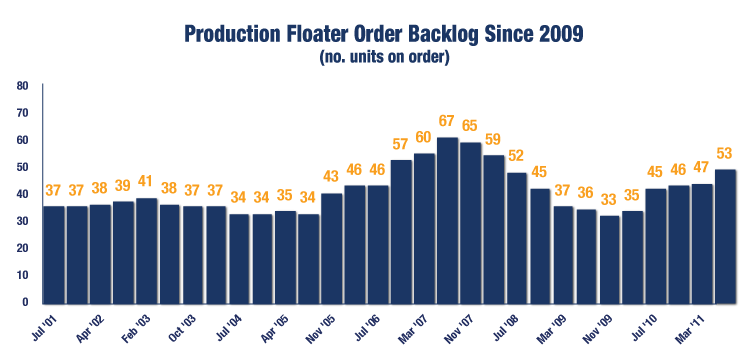
Current order backlog consists of 53 production floaters, a net increase of six units since March. This extends the buildup in backlog that began in the second half of 2009. Twenty-eight units utilize purpose-built hulls, 25 are based on converted tanker hulls. Twenty units are being built for leasing operators, 33 directly for field operators.

In the report, IMA identifies 196 projects in the bidding, design or planning stage that potentially require a floating production or storage system. These projects are declared discoveries or planned develop where a floating production or storage system is being considered as the development option.

Of the 196 planned projects, 53 are in the bidding or final design stage. Major hardware contracts for these projects are likely to be awarded within the next 12 to 18 months. Another 143 floating projects are in the planning or study phase. Major hardware contracts for these projects are likely in the 2013 to 2018 timeframe.

Brazil is the most active region for future projects, with 50 potential floater projects in the planning cycle. Southeast Asia is second with 37 projects, followed by West Africa with 36 projects, Northern Europe with 22 projects, Gulf of Mexico with 17 projects and Australia with 11 projects.

Currently, 256 floating production systems are in service or available worldwide; FPSOs comprise 62 percent of this inventory. The balance of the fleet is comprised of production semis with 17 percent; nine percent is tension leg platforms; seven percent is production spars; and five percent is production barges and FSRUs. Of the total production floater inventory, 11 units are currently off field and available for reuse – making the effective utilization rate of 95.7 percent.

Oil & Gas Post

Promote Your Page Too
LINK

Thursday, July 21, 2011

Floating LNG to Play Greater Role in Global Gas Development

- Floating LNG to Play Greater Role in Global Gas Development

Thursday, July 21, 2011
Rigzone Staff
by Karen Boman

While floating liquefaction technology has yet to be commercially proven, the success of floating liquefied natural gas (FLNG) could open previously stranded or non-commercial gas reserves worldwide.

In May, Shell made the final investment decision to proceed with the development of its Prelude floating LNG project. Shell's Prelude facility, which will be deployed in the Browse Basin offshore Northwest Australia, will be the largest floating structure ever built.

While Shell's decision to push ahead with the Prelude project is a major breakthrough for FLNG liquefaction, the unit will not come on stream until the second half of the decade, said Douglas-Westwood analyst Lucy Miller. There are a number of other projects ongoing, but it's likely that these will also fall into this timeframe; no other projects have been approved. "On the whole, onshore developments are still favored; however, FLNG may prove to be more competitive in certain cases depending on the specific project's requirements."


Austral-Asia is seen as a key region for FLNG, particularly the Timor Sea offshore Australia and Papua New Guinea; other key areas include Southeast Asia and offshore Brazil, Miller said.

Douglas Westwood last year estimated that over $23 billion would be spent on FLNG development from 2010 to 2016, most of which will be spent on liquefaction facilities. During that time, Australia is expected to dominate the FLNG market with $5.3 billion in projects, followed by Africa with $5.2 billion in projects and Asia with $4.7 billion in projects. While North America has the greatest number of FLNG prospects, North American projects are expected to account for only seven percent of global expenditures from 2010 to 2016.

Douglas-Westwood views FLNG solutions as a solution for monetizing stranded gas assets that lie far offshore and distant to production infrastructure, addressing the security issues of onshore facilities and pipelines or boundary disputes such as the Timor Sea and South China Sea, and creating a market for gas that would normally be flared.

Accessing stranded gas reserves will be critical to meet the anticipated rise in global gas demand due to population and economic growth, particularly in emerging economies such as China. Douglas-Westwood notes that 6,531 Tcf of gas reserves remain worldwide; 3,000 Tcf of these reserves are considered stranded gas assets.

FLNG may allow Europe other gas supply options that could wean its dependence on Russian gas. More than 40 percent of the European Union's gas is imported -- about half of which comes from Russia – and imports are expected to rise to 75 percent by 2030. Europe's dependence on Russian imports makes it vulnerable to price hikes and supply cut-offs, as demonstrated when Gazprom doubled prices and cut supply going to the Ukraine, Lithuanian, Belarus and Georgia from 2006-2009.

FLNG import terminals are operating in Argentina, Brazil, Kuwait, the UK and the U.S. These include a mix of technological concepts such as regasification vessels and floating storage and regasification units. Some of the technologies involved in proposed FLNG projects have yet to be proven, Douglas-Westwood noted. Technical challenges facing FLNG development include development of sloshing-resistant containment systems; cryogenic offloading, side by side by loading arms or by tandem offloading; marinisation of liquefaction processing equipment; field specific and general topside modules; and the need to develop multiple small-scale or large-scale FLNG vessels, or vessels between 1 and 3 mmtpa and greater than 3 mmtpa.

Besides Shell, other companies seeking to develop liquefaction FLNG facilities include Flex LNG, Petrobras, SBM Offshore, Bluewater, Hoegh LNG, Excelerate Energy, ConocoPhillips and Sevan Marine are developing FLNG liquefaction design concepts, but no specific fields have been announced.

The anticipated start of operations on Flex LNG's FLNG project in Papua New Guinea (PNG) in 2014 is "perfect timing" for the anticipated wave of Asian LNG demand, Flex LNG reported earlier this year. Flex LNG in April entered agreements agreement with Interoil, Pacific LNG, Liquid Niugini Gas Ltd., and Samsung Heavy Industries for a FLNG project in PNG that would liquefy natural gas from the onshore Elk and Antelope gas fields in PNG's Gulf Province.

Samsung last month began field specific front-end engineering and design work (FEED) for the hull portion of the FLNG vessel. WorleyParsons and Kanfa Aragon will carry out the FEED work for the topsides. Samsung will remain responsible for the overall design, engineering, construction and commissioning of the FLNG vessel. FEED is set to be completed in time for the project to reach a Final Investment Decision before the end of this year, with operations in PNG targeted to begin in 2014.

FLEX LNG has already completed a generic FEED in 2009 and the field specific FEED will tailor the vessel for the PNG project where the FLNG vessel is expected to be moored alongside a jetty and have a nominal production capacity of close to 2 million tons of LNG per annum and to process an estimated 2.25 trillion cubic feet of gas over a firm 25-year period. The Elk and Antelope gas fields have substantial certified gas resources, with 6.5 Tcf of P90 resources and 8.6 Tcf and 10 Tcf in P50 and P10 estimates respectively.

Flex LNG reported that LNG projects are more costly than ever to develop, as the capital expenditures/ton of installed liquefaction capacity has made a permanent shift over the last decade from an average figure below 500USD/ton to typical range of 1,500-2,500 USD/ton. Due to the uniqueness of projects, current LNG development costs exceed the average cost for the oil and gas industry. Flex LNG anticipates that it will be in the lower end of the USD550-700 ton/liquefaction capacity CAPEX range for its PNG project.

Oil & Gas Post

Promote Your Page Too
LINK

Wednesday, July 20, 2011

Australia to Dominate Floating LNG Market through 2016

- Australia to Dominate Floating LNG Market through 2016

Wednesday, July 20, 2011
Rigzone Staff
by Karen Boman

Australia's proximity to growing liquefied natural gas (LNG) demand in Asia, its sizable conventional and unconventional gas resources, stable fiscal regime and accessibility to international oil and gas companies, are driving LNG development in the Land Down Under.

UK-based energy research and analysis firm Douglas-Westwood reported that Australia will dominate the floating LNG market between 2010 and 2016 with $5.3 billion in projects. Thirty-six million tones per annum (mtpa) of LNG is under construction in Australia, and more than 120 mtpa is being proposed or in the planning stages, a number that keeps growing as companies discover additional gas reserves, according to the International Gas Union (IGU) World LNG Report 2010.


Australia currently produces 20 mtpa of LNG, but this production level could rise to more than 60 mtpa by 2016 and by 2035, a third of all planned production from proposed and sanctioned LNG projects could come from Australia, said Peter Cleary, VP of Corporate Strategy and Development for Santos Ltd.

LNG development in Australia is being driven partly by development of conventional gas reserves and by coal-bed methane gas to LNG projects, IGU noted. LNG projects under construction include Shell's Prelude floating LNG project, Woodside's Pluto project and Chevron's Gorgon LNG project. These projects represent 25 mtpa.

In Australia, the rapid rise of coal seam gas exploration, development and production has resulted in new additions to its supply. The revolution in coal seam methane has resulted in 16 mtpa of LNG supply from coal seam gas being sanctioned in the past year; another project may be sanctioned later this year, said Cleary.

Shell's recently sanctioned Prelude FLNG project will be one of the biggest game changers the industry will see. FLNG will unlock stranded gas fields, making these reserves commercially viable. "At Santos we are confident our Bonaparte LNG venture with GDF Suez will be another pioneering project in this field," Cleary said.

Santos, Australia's largest domestic gas producer, has a unique LNG portfolio consisting of its Darwin conventional gas supply project, a stake in the ExxonMobil-operated LNG project in Papua New Guinea focused on the Hides gas/condensate field, the coal seam gas to LNG project at Gladstone, and the Bonaparte floating LNG project.

Looking forward to the future LNG market, Cleary sees LNG exporters becoming importers, the increasing importance of partnership with national oil companies, increased market liquidity and trade flow complexities, and new technologies enabling the development of coal seam gas, shale gas, floating LNG and regasification and storage.

Historically, Australian coal bed methane, or coal seam gas development, has typically been part of an integrated power generation effort and/or focused on local retail gas distribution. But more recently, the engine of growth for coal seam gas has shifted to Australia, where there are hopes and plans to link the country's well known and readily accessible reserves and resources to the expected strong demand growth for gas in Asian markets, according to a Ernst & Young report, Coal seam gas: broadening the energy mix.

However, expanded coal seam gas supplies in Australia will face intense gas-on-gas competition, not only from other Australia gas/LNG projects but from other Southeast Asia sources as well as from the Middle East and Russia, Ernst & Young noted.

Australia LNG Project Update

Australia currently is the fifth largest LNG exporter worldwide, and the Australian oil and gas industry is seeking to make Australia the world's first or second largest LNG exporter by 2020, the Australian Petroleum Production and Exploration Association (APPEA) said.

At present, Qatar is the largest LNG exporter with approximately 77 mpta, nearly four times that of Australia's LNG export capacity. While a number of projects are planned for Australia, the majority of these projects will have to move forward if Australia were to replace Qatar as the top LNG exporter. Australia-based LNG projects also face challenges from the isolation of prospective sites, which makes sourcing difficult, environmental issues, aboriginal land rights and political issues. Westwood noted that the Greater Sunrise LNG project is being held back because the Timor Leste government wants an onshore plant rather than FLNG.

Shell in May made the final investment decision for its plans to produce gas from the Prelude field via an FLNG facility. Prelude is located in the Browse Basin, northeast of Broome Western Australia, in water depths of approximately 820 feet. According to APPEA, the country currently has two producing LNG developments, including the North West Shelf and Darwin projects, with three projects under construction in northern Western Australia, Pluto, Gorgon and Prelude, and two in Queensland - Queensland Curtis and Gladstone LNG.

Woodside Energy in late June signed a Native Title Agreement that would establish the Browse LNG Precinct near James Price Point north of Broome in Western Australia. The agreement will allow Woodside to proceed with development of its Browse LNG project. Meanwhile, the first LNG cargo delivery from Woodside's Pluto LNG project will take place in March 2012; the scheduling delay has been attributed to slower than expected progress on the commissioning of the onshore gas plant, seven weeks of direct weather delays and an allowance for an increased contingency. The revised estimate is expected to result in an A$900 million increase in cost to a total of A$14.9 billion (100% project). This estimate includes arrangements with customers affected by the delay.

Japan-based Inpex has received environmental approval from the Australian government for its Ichthys LNG project, paving the way for a final investment decision in this year's fourth quarter. The proposed project includes a subsea production system, semisubmersible central processing facility, a floating production, storage and offtake vessel located in the Ichthys field in the Browse Basin, approximately 124 miles offshore the northwest coast of Western Australia. Onshore gas processing facilities will be located at Blaydin Point, near Darwin. A 549-mile subsea gas pipeline will link the offshore and onshore facilities. Ichthys is expected to product 8.4 million tones of LNG and 1.6 million tones of LPG (liquefied petroleum gas) per year.

Oil & Gas Post

Promote Your Page Too
LINK

Friday, June 10, 2011

Shell to Set Record with Prelude Floating LNG Structure

- Shell to Set Record with Prelude Floating LNG Structure

Friday, June 10, 2011
Rigzone Staff
by Karen Boman

Shell's Prelude floating liquefied natural gas (FLNG) facility, which will be deployed in the Browse Basin offshore Northwest Australia, will be the largest floating structure ever built. At 1,601 feet long, the facility will be the length of 175 Olympic swimming pools, and at 600,000 tonnes, weigh six times of that of the largest aircraft carrier.

It will include 260,000 tonnes of steel, about five times more than was used to build the Sydney Harbor Bridge. The facility also will produce enough offtake to supply 90 percent of Hong Kong's energy needs.

While Shell will achieve a technological breakthrough with the facility, the forecast increase in energy demand due to the growing global population and emerging economies of countries such as China, as well as the need to reduce global greenhouse gas emissions, is driving Shell's FLNG development.

Shell to Set Record with Prelude Floating LNG Structure
Shell's Prelude Floating LNG

"We really do envision the next few years to be a golden age of gas," said Neil Gilmour, Shell' general manager for floating LNG, at a meeting in Houston this week. Gilmour was referencing the recent report by the International Energy Agency (IEA) that natural gas would play a greater role in the global energy mix. IEA estimates that global use of gas will rise by more than 50 percent from 2010 levels and account for more than a quarter of global energy demand by 2035.

The ability to quickly construct and deploy LNG facilities that could be utilized on multiple fields will become critical as global energy demand rises. To meet this need, Shell sought to create Prelude as a FLNG facility as a design template that could be standardized. Gilmour said he anticipates that Shell will be able to deploy its vessel design more quickly and efficiently in time as it carries out more projects.

Shell's board last month made the final investment decision for the project, but the project's development has been underway for some time. The initial investment in the design phase, which included around 650 workers and generated 1.6 million project man hours and nearly 3,000 engineering drawings, was critical for Shell to ensure the vessel's integrity and design, Gilmour said, noting that, "since this is going to be cloned, we wanted to get the fundamentals right."

Production of liquids will depend upon the specifics of each gas reserve, and the upstream design will be project specific. Shell's design is aimed at fields containing between 2 to 3 Tcf of gas or larger, but is standardized to maximize redeployment opportunities with fields as small as 1.5 to 2.0 Tcf considered feasible. Fields larger than 3 Tcf also can be developed using multiple FLNG facilities.

The structure, which will be used to produce the Prelude and Concerto fields, has been designed to withstand metocean conditions of up to a Category 5 cyclone and waves up to 65 feet high, meaning that the vessel will not need to be moved or disconnected. The vessel will be towed to the site, located approximately 124 miles offshore in once construction is complete, and is fitted with steam-driven generators to create electrical power on board the facility. Gas-driven generators may be used in the future, but Shell determined that steam-driven would be the most efficient at this time.

The facility, which will be located over the Prelude field, will produce 3.6 million tones per annum (mtpa) of LNG, 1.3 mtpa of condensate and .4 mtpa of LPG, which will be offloaded every six to seven days. The facility will have storage capacity of 220,000 cubic meters of LNG, 90,000 cubic meters of LPG, and 126,000 cubic meters of condensate, with a double row membrane for LNG/LPG storage. Prelude and Concerto are estimated to hold 3 Tcf of gas.

The concept will have a wide enough design envelop to accommodate gas with varying carbon dioxide (CO2) content to allow the processing of a range of different feed gas compositions without the need to redesign significant parts of the topsides. The gas in fields that could be tied back to Prelude, which lie within a 62 mile radius of the structure's site, have a CO2 content of between seven and eight percent, Gilmour said. Gilmour anticipates the hull will have a 50 year life span; after the first 25 years, the hull will be dry docked for refurbishment before being redeployed another 25 years.

Construction will take place at Geoje Island shipyards in South Korea, one of the few places in the world with a dry dock big enough to construct a facility of this size. Seven thousand workers, including 250 from Shell, will work on the dry dock construction phase, which is expected to last six months. One limiting factor in FLNG size will be the number of dry dock facilities available for construction of larger vessels such as Geoje Island, meaning that more emphasis will be placed upon making more efficient use of space for adding equipment on board, Gilmour said.

Besides Australia, Gilmour sees opportunity for floating LNG projects offshore East Africa, Indonesia, New Zealand, Brazil, Venezuela, West Africa and the Mediterranean Sea. Gilmour said that a floating LNG facility could be the solution for areas with territorial disputes or that would require a bilateral agreement on a field development plan, and a more acceptable option than pipelines.

Utilizing the Prelude FLNG design on the Sunrise FLNG facility in the Timor Sea will be even easier than for Prelude because Sunrise is bigger and has gas containing lower levels of carbon dioxide. "The fact that we got the Sunrise LNG project is a big tick in the box for Shell," Gilmour said.

Oil & Gas Post

Promote Your Page Too

Friday, May 20, 2011

Shell to Develop World's 1st Floating LNG Proj.

- Shell to Develop World's 1st Floating LNG Proj.

Friday, May 20, 2011
Royal Dutch Shell plc

Shell's final investment decision announced to proceed with the development of its Prelude Floating LNG Project will deliver billions in economic benefits and put Australia on the map as a world leader in this cutting-edge technology.

Analysis indicates Prelude will add over $45 billion to Australia's GDP, create around 1,000 jobs, contribute $12 billion in tax revenues, spend $12 billion on Australian goods and services and improve Australia's balance of trade by at least $18 billion over the 25-year life of the project.

The facility will be the largest floating structure ever built and will be used to develop both the Prelude and Concerto fields in the Browse Basin about 475km north-northeast of Broome.

Welcoming the announcement in Perth, the Minister for Resources and Energy, Martin Ferguson AM MP, congratulated Shell on its decision which reflects continued confidence in Australia as an investment destination for major projects.

"Today's announcement by Shell comes after many years of hard work to get this project off the ground," Minister Ferguson said.

"It opens the doors to countless new opportunities both here in Australia and around the world to use new technology that makes it more economical to develop remote deposits.

"Floating LNG technology can unlock petroleum resources that are either too far from existing infrastructure or too small to develop via a conventional LNG project and has the added benefit of a smaller environmental footprint.

"This project will also be Shell's first upstream development in Australia as operator and I welcome their intention to invest even further here in coming years.

"It is also important not to lose sight of the longer term benefits Prelude will deliver. In addition to the jobs, increased revenue and opportunities for local companies it will create, Shell will also use Prelude to offer training, education and research opportunities in Australia.

"Australia is already the world's fourth-largest LNG exporter. This year we forecast our LNG exports to be worth more than $8 billion. Projects like Prelude put us securely on the road to becoming the world's second-largest exporter of LNG in the near future."

The Commonwealth Government has granted environmental approvals for Prelude. The project will be subject to strict environmental conditions to ensure any environmental impacts are managed and minimised.

Shell's final investment decision announced to proceed with the development of its Prelude Floating LNG Project will deliver billions in economic benefits and put Australia on the map as a world leader in this cutting-edge technology.

Analysis indicates Prelude will add over $45 billion to Australia's GDP, create around 1,000 jobs, contribute $12 billion in tax revenues, spend $12 billion on Australian goods and services and improve Australia's balance of trade by at least $18 billion over the 25-year life of the project.

The facility will be the largest floating structure ever built and will be used to develop both the Prelude and Concerto fields in the Browse Basin about 475km north-northeast of Broome.

Welcoming the announcement in Perth, the Minister for Resources and Energy, Martin Ferguson AM MP, congratulated Shell on its decision which reflects continued confidence in Australia as an investment destination for major projects.

"Today's announcement by Shell comes after many years of hard work to get this project off the ground," Minister Ferguson said.

"It opens the doors to countless new opportunities both here in Australia and around the world to use new technology that makes it more economical to develop remote deposits.

"Floating LNG technology can unlock petroleum resources that are either too far from existing infrastructure or too small to develop via a conventional LNG project and has the added benefit of a smaller environmental footprint.

"This project will also be Shell's first upstream development in Australia as operator and I welcome their intention to invest even further here in coming years.

"It is also important not to lose sight of the longer term benefits Prelude will deliver. In addition to the jobs, increased revenue and opportunities for local companies it will create, Shell will also use Prelude to offer training, education and research opportunities in Australia.

"Australia is already the world's fourth-largest LNG exporter. This year we forecast our LNG exports to be worth more than $8 billion. Projects like Prelude put us securely on the road to becoming the world's second-largest exporter of LNG in the near future."

The Commonwealth Government has granted environmental approvals for Prelude. The project will be subject to strict environmental conditions to ensure any environmental impacts are managed and minimised.

Oil & Gas Post

Promote Your Page Too