Crude Oil Price by oil-price.net

Oil and Gas Energy News Update

Showing posts with label record. Show all posts

Wednesday, August 24, 2011

Tullow Touts Record Results in 1H11

- Tullow Touts Record Results in 1H11

Wednesday, August 24, 2011
Tullow Oil plc

Tullow announced its half-yearly results for the six months ended 30 June 2011.

2011 Half-yearly results summary
  • Record first half revenue and profit
  • Interim dividend doubled
  • Exploration success continues and developments being progressed

Tullow had a very strong first half. Record results were driven by increased production from the Jubilee field in Ghana and higher commodity prices. Exploration and appraisal success continued and the Group strengthened its portfolio with farm-ins in East Africa and two strategic acquisitions. Further progress was made in Uganda and Tullow now expects completion of its farm-down to CNOOC and Total in September. In July the Group listed Tullow Oil plc shares on the Ghana Stock Exchange.

Key highlights
  • Record sales revenue of over $1 billion driven by Jubilee Production; interim dividend doubled.
  • 71% exploration and appraisal success year-to-date (17/24); Akasa-1 discovery announced today.
  • Completion of farm-in to six blocks in Kenya and Ethiopia; first well to spud in Kenya in Q4 2011.
  • Group production expected to average 82-84,000 bopd for 2011 and exceed 100,000 bopd by year-end.
  • Jubilee production in Ghana is expected to increase to 105,000 bopd in October; plateau production of 120,000 bopd is now expected before year-end.
  • MoU signed with the Government of Uganda; $2.9 billion Sale and Purchase Agreements signed for the farm-down to CNOOC and Total; completion now expected in September.
  • Nuon E&P and EO Group acquisitions completed in June and July respectively.
  • Secondary listing on the Ghana Stock Exchange completed in July following successful $72.3 million offer.

Commenting, Aidan Heavey, Chief Executive, said, "We have delivered a strong performance and achieved record results in the first half allowing us to double the dividend. We continue to make good progress with production plans in both Ghana and Uganda and while delays to the farm-down to CNOOC and Total have been frustrating, we now expect completion in September. With a strong balance sheet, growing production and a potentially transformational drilling campaign to come, we move into the second half of the year with real confidence."

Oil & Gas Post

Promote Your Page Too
LINK

Tuesday, August 9, 2011

Carrizo Reports Record Production for 2Q11

- Carrizo Reports Record Production for 2Q11

Tuesday, August 09, 2011
Carrizo O&G Inc.

Carrizo announced financial results for the second quarter of 2011, which included the following highlights:

Results for the Second Quarter of 2011
  • Record production of 11.2 Bcfe, or 122,788 Mcfe/d
  • Revenue of $50.7 million or adjusted revenue, of $54.1 million, including the impact of realized hedges
  • Net Income of $7.7 million, or Adjusted Net Income, as defined below, of $9.5 million
  • EBITDA, as defined below, of $41.8 million

Production volumes during the three months ended June 30, 2011 were a record 11.2 Bcfe, an increase of 1.9 Bcfe, or 20%, from second quarter 2010 production of 9.3 Bcfe and an increase of 0.5 Bcfe, or 5% from first quarter 2011 production of 10.7 Bcfe. The increase in production from the second quarter of 2010 and the first quarter 2011 to the second quarter of 2011 was primarily due to increased production from new wells in the Barnett Shale, Eagle Ford Shale and Niobrara Formation, partially offset by normal production decline and the sale of substantially all of our non-core area Barnett Shale properties to KKR Natural Resources ("KKR") in May 2011.

Adjusted revenues were $54.1 million for the second quarter of 2011, which includes oil and gas revenues of $50.7 million and realized hedge gains of $3.4 million, compared to $43.5 million for the second quarter of 2010, which includes oil and gas revenues of $32.9 million and realized hedge gains of $10.6 million. The increase in adjusted revenues was primarily driven by increased production, particularly higher oil and condensate production in the Eagle Ford Shale, and higher oil prices partially offset by lower realized hedge gains. Including the impact of realized hedges, the Company's average realized gas price decreased 13% to $3.83 per Mcfe for the second quarter of 2011 compared to $4.40 per Mcfe for the second quarter of 2010 and the average realized oil price increased 1% to $93.90 per barrel for the second quarter of 2011 compared to $93.30 per barrel for the second quarter of 2010. Revenues excluding the impact of realized hedges are presented in the table below.

Adjusted net income, which excludes certain non-cash items described in the statements of operations included below ("Adjusted Net Income"), was $9.5 million, or $0.25 and $0.24 per basic and diluted share, respectively, during the second quarter of 2011, including a $3.3 million benefit of cash distributions received from a joint venture partner as described below, as compared to $11.3 million, or $0.33 per basic and diluted share, during the second quarter of 2010. The Company reported net income of $7.7 million, or $0.20 per basic and diluted share, for the quarter ended June 30, 2011, as compared to net income of $1.8 million, or $0.05 per basic and diluted share, for the same quarter during 2010.

Earnings before interest, income tax, depreciation, depletion and amortization ("EBITDA") as defined in the Company's new U.S. senior secured revolving credit facility ("Credit Facility") and described in the statements of operations included below was $41.8 million, or $1.07 and $1.06 per basic and diluted share, respectively, during the second quarter of 2011, including the $3.3 million benefit of cash distributions received from a joint venture partner as described below, as compared to $31.6 million, or $0.93 and $0.92 per basic and diluted share, respectively, during the second quarter of 2010. During the second quarter of 2011, the Company received cash distributions of $3.3 million on its B Unit investment in ACP II Marcellus, LLC ("ACP II"), a joint venture partner in the Marcellus Shale that is an affiliate of Avista Capital Partners, LP, a private equity fund, as a result of ACP II's distribution to Avista of remaining proceeds from its sale of oil and gas properties to an affiliate of Reliance Industries Limited ("Reliance"). Although such cash distributions are included in EBITDA and Adjusted Net Income, such cash distributions are recognized as a reduction of oil and gas property costs under the full cost method of accounting and accordingly are not included in net income.

Lease operating expenses (including transportation costs of $1.6 million) were $7.4 million (or $0.66 per Mcfe) for the three months ended June 30, 2011 as compared to lease operating expenses (including transportation costs of $1.5 million) of $6.2 million (or $0.66 per Mcfe) for the second quarter of 2010. Lease operating expenses increased due to increased production primarily attributable to new wells in the Barnett Shale, Eagle Ford Shale and Niobrara Formation. Although we continued to experience a decrease in the operating cost per Mcfe of our Barnett Shale production, driven by comparatively less salt water disposal costs in the core area of the Barnett Shale as compared to production from other areas of the Barnett Shale, this decrease was offset by increased operating cost per Mcfe associated with higher cost oil production.

Production taxes were $1.5 million (or 2.89% of revenues) for the three months ended June 30, 2011 as compared to $0.9 million (or 2.69% of revenues) for the three months ended June 30, 2010. The increases in production taxes and the percentage of revenues are due to increased oil production, which has a higher effective production tax rate as compared to natural gas.

Ad valorem taxes increased to $1.0 million (or $0.05 per Mcfe) for the three months ended June 30, 2011 from $0.5 million ($0.09 per Mcfe) for the same period in 2010. The increase in ad valorem taxes is due to new oil and gas wells drilled in 2010 as well as a reduction in ad valorem taxes recorded in the second quarter of 2010 reflecting a true up of our first quarter 2010 estimate. The decrease in the per Mcfe amounts is due primarily to this true up of the first quarter 2010 estimate.

General and administrative expense was $5.7 million during the three months ended June 30, 2011 as compared to $4.3 million during the three months ended June 30, 2010. The increase was primarily due to increased compensation costs related to an increase in the number of employees in the second quarter of 2011.

Depreciation, depletion and amortization ("DD&A") expense for the three months ended June 30, 2011 increased to $20.6 million (or $1.84 per Mcfe) from $11.1 million (or $1.19 per Mcfe) for the same period in 2010. The increases in DD&A and the related per Mcfe amounts were primarily due to increased production during the second quarter of 2011 as compared to the same period in 2010 and increased future development costs associated with crude oil and natural gas liquids reserves in the Eagle Ford which were added during the fourth quarter of 2010 and have a higher future development cost per equivalent unit than the Company's proved gas reserves. The increase in the second quarter 2011 forecasted DD&A of $1.58 per Mcfe to the actual DD&A of $1.84 per Mcfe is largely due to increased production in the second quarter of 2011 as compared to the first quarter of 2011 as well as an increase in prior year's estimated future development costs in the Eagle Ford.

Cash interest expense, net of amounts capitalized, increased to $6.1 million for the second quarter of 2011 compared to $2.9 million for the second quarter of 2010. The increase was primarily attributable to interest on the $400 million aggregate principal amount of Senior Notes issued in the fourth quarter of 2010 partially offset by decreased interest attributable to the $300 million aggregate principal amount of Convertible Senior Notes repurchased in a tender offer during the fourth quarter of 2010.

An unrealized gain on derivatives of $8.1 million was recorded for the second quarter of 2011 compared to an unrealized loss on derivatives of $7.4 million for the second quarter of 2010 due to the change in fair value of our open derivative positions during those periods.

Non-cash, stock-based compensation expense increased to $6.8 million for the three months ended June 30, 2011 from $3.2 million for the same period in 2010. The increase was largely attributable to additional stock appreciation rights as well as stock appreciation rights that increased in fair value.

Non-cash interest expense, net of amounts capitalized, decreased to $0.7 million for the second quarter of 2011 compared to $1.9 million for the second quarter of 2010, primarily due to decreased amortization of the discount as a result of the $300 million aggregate principal amount of the Convertible Senior Notes repurchased in a tender offer during the fourth quarter of 2010.

During the second quarter of 2011, we contributed $1.0 million in common stock to the Carrizo Oil & Gas, Inc. endowed scholarship fund at the University of Texas at Arlington ("UTA") where we are producing natural gas from a number of wells in the Barnett Shale play.

The effective income tax rate was 31.8% for the second quarter of 2011 and 15.0% for the second quarter of 2010. Our estimated annual effective income tax rate for 2011 is approximately 37%, substantially all of which we expect to be deferred. The effective income tax rate for the second quarter of 2011 was lower than 37% primarily due to the true up of prior estimates of the foreign tax benefit associated with the Company's UK Huntington field development. The lower rate in the second quarter of 2010 was due to a true up of prior estimates of state income tax.

Carrizo's President and CEO, S. P. "Chip" Johnson, IV, commented on recent activity, "In late July we initiated sales from a three well pad producing from the Eagle Ford Shale on our Mumme lease in La Salle County, Texas, and from our Orlando Hill well in the Niobrara Formation. These events marked an inflection point in our liquids production growth ramp. We anticipate the oil production from these new wells to be followed by a fairly steady increase for the remainder of the year, with each month's oil production sequentially higher than the last, as a sufficient inventory of drilled wells has been built in the Eagle Ford and Niobrara to allow the execution of a continuous completion program.

"While still flowing back significant quantities of completion fluid, the Mumme 30H, 31H and 32H have each reached rates between 920 BOE per day and 1,184 BOE per day, consisting of 720-984 barrels of oil and approximately 1,200 Mcf of high BTU natural gas which went directly to sales in the existing lease gas gathering system. Following stabilization, we intend to flow these wells at constrained rates to maximize ultimate recoveries. We expect to begin completion of a three well pad on the Glover lease in Atascosa County later this month and anticipate first sales to occur in mid-September. Our recently completed well in the Niobrara Formation, the Orlando Hill 26-44-8-61 in Weld County, Colorado, reached a peak 24 hour production rate of 650 bopd on July 17th and averaged 580 bopd over the following week. The Nelson 17-44-9-60 well has also been completed and is currently flowing back completion fluid with a strong oil cut. An additional Niobrara well, the Wickstrom 7-11-5-60, has been drilled to total depth and is scheduled for completion later this month. We continue to be satisfied with the results of our Niobrara program and expect to be able to average adding a new well to production each month for the rest of 2011.

"The production contribution from our Eagle Ford completion program and our Niobrara activity should allow us to exit the year 2011 at or above our previous guidance of 5,000 net bopd. This growth in liquids production, in addition to the improved well performance from the Barnett Shale, gives us confidence in meeting our 2011 production growth forecast of 32% (after adjustment for the sale of a portion of our Barnett Shale properties to KKR earlier this year)."

Oil & Gas Post

Promote Your Page Too
LINK

Thursday, August 4, 2011

Apache 2Q Earnings Buoyed by Record Production

- Apache 2Q Earnings Buoyed by Record Production

Thursday, August 04, 2011
Apache Corp.

Apache reported production of 749,000 barrels of oil equivalent (boe) per day and earnings of $1.2 billion, or $3.17 per diluted share, for the three-month period ending June 30, 2011. These compare with production of 647,000 boe per day and net income of $860 million, or $2.53 per diluted share, for the same period in the prior year.

"Apache had an outstanding quarter with record production in oil, gas, and natural gas liquids," said G. Steven Farris, chairman and chief executive officer. "This reflects the scale and balance of our portfolio, which comes from diversity across geographic regions, gas and liquids production, and a constant focus on rate of return. We're realizing additional value from last year's acquisitions and pursuing opportunities for future growth at both our legacy assets and in new areas."

The combination of higher oil prices and record production levels resulted in record quarterly revenues for second quarter 2011. Oil and gas revenues were $4.4 billion, a 47 percent increase from revenues of $3.0 billion for the same period last year. Cash from operations before changes in operating assets and liabilities* also were a quarterly record at $2.6 billion, up 44 percent from the prior year's $1.8 billion. Excluding certain items that management believes affect the comparability of operating results, Apache reported adjusted earnings* of $1.3 billion in second quarter 2011 compared with $834 million in the year-earlier period. On a per-share basis, adjusted earnings were $3.22 in the second quarter compared with $2.46 per diluted share in the prior-year period.

Liquid hydrocarbons represented 49 percent of production and 78 percent of revenues. Apache benefited from higher oil prices for its international production indexed to Dated Brent benchmarks, as well as sweet crudes from the Gulf of Mexico, which continue to receive a meaningful premium per barrel compared with production benchmarked to West Texas Intermediate prices.

On the operational and commercial front, the company has achieved several recent milestones. These include:
  • Successful bidder on nearly 515,000 acres in onshore and offshore state leases at Alaska's Cook Inlet. The company now has approximately 800,000 acres of prospective land in the region, and a seismic survey for the area is planned over the next 12-18 months.
  • Signing of a long-term sales and purchase agreement with Tokyo Electric Power (TEPCO) for liquefied natural gas (LNG) from the Wheatstone LNG project in Western Australia. The Wheatstone partners (Apache, Chevron and a subsidiary of Kuwait Foreign Petroleum Co.) will supply TEPCO with 3.1 million metric tons per annum when the facility comes online, which will be determined at project sanction forecasted for later this year. Apache's expected net share of LNG sales to TEPCO is equivalent to approximately 58 million cubic feet of natural gas per day.
  • Unitization of portions from four leases at the Lucius deepwater oil and gas discovery in the Gulf of Mexico, where Apache and its partners also signed an agreement that allows for joint venture processing of gas from a nearby third-party discovery.
  • Agreement to a 50-50 partnership to build additional gas processing infrastructure in the Permian Basin. A new gas processing plant will remove constraints to higher production at the Deadwood field, where Apache is currently running nearly half of its 24 rigs in the region.
  • Commencement of production from Apache's most prolific development well in the Forties field (North Sea), which came online in excess of 12,500 barrels of oil per day. A second development well also completed in June came online at a daily rate of nearly 8,800 barrels of oil.
  • Drilling of five new field discoveries in the Faghur basin of Egypt's Western Desert. In aggregate the wells tested at rates exceeding 12,000 barrels of oil per day and 19 million cubic feet of natural gas.

"Our regional business model is central to our value creation," Farris said. "It provides us with many ways to win -- we're not dependent on any single market or play. This results in more predictable, profitable long-term growth."

Oil & Gas Post

Promote Your Page Too
LINK

Wednesday, August 3, 2011

Record Pace Seen for Floating Production Systems

- Record Pace Seen for Floating Production Systems

Wednesday, August 03, 2011
Rigzone Staff
by Karen Boman

Growth in world oil demand, strong oil prices and concerns over supply disruption are among the factors driving growth in the floating production market, according to a recent report by the International Maritime Associates (IMA).

Fourteen floating production units have been ordered over the past four months - including the world's first floating liquefied natural gas (FLNG) vessel – a record pace reflecting strong underlying market drivers, according to IMA. The 1.5 percent to two percent growth in global oil demand per year means that new sources of oil supply need to be developed. To develop these resources, oil and gas companies are increasing their deepwater exploration and production spending.


Jim McCaul, head of IMA, said, "Few if any business sectors can match the dynamism, growth predictability and investment attractiveness of the floating production market."

At $3 billion, the Prelude FLNG is the most expensive floating production unit ordered to date. Other orders include nine floating production storage offloading vessels (FPSOs) - including one purpose-built unit, six units converted from trading tanker hulls and two modification/redeployments - two production spars and two purpose-built floating storage regasification units (FSRUs). Total value of the 14 construction contracts exceeds $11 billion.

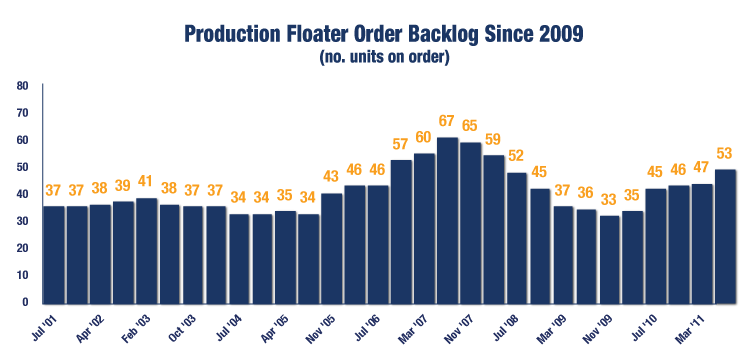
Current order backlog consists of 53 production floaters, a net increase of six units since March. This extends the buildup in backlog that began in the second half of 2009. Twenty-eight units utilize purpose-built hulls, 25 are based on converted tanker hulls. Twenty units are being built for leasing operators, 33 directly for field operators.

In the report, IMA identifies 196 projects in the bidding, design or planning stage that potentially require a floating production or storage system. These projects are declared discoveries or planned develop where a floating production or storage system is being considered as the development option.

Of the 196 planned projects, 53 are in the bidding or final design stage. Major hardware contracts for these projects are likely to be awarded within the next 12 to 18 months. Another 143 floating projects are in the planning or study phase. Major hardware contracts for these projects are likely in the 2013 to 2018 timeframe.

Brazil is the most active region for future projects, with 50 potential floater projects in the planning cycle. Southeast Asia is second with 37 projects, followed by West Africa with 36 projects, Northern Europe with 22 projects, Gulf of Mexico with 17 projects and Australia with 11 projects.

Currently, 256 floating production systems are in service or available worldwide; FPSOs comprise 62 percent of this inventory. The balance of the fleet is comprised of production semis with 17 percent; nine percent is tension leg platforms; seven percent is production spars; and five percent is production barges and FSRUs. Of the total production floater inventory, 11 units are currently off field and available for reuse – making the effective utilization rate of 95.7 percent.

Oil & Gas Post

Promote Your Page Too
LINK

Record Output, Higher Prices Drive Devon's 2Q Profit to $2.7B

- Record Output, Higher Prices Drive Devon's 2Q Profit to $2.7B

Wednesday, August 03, 2011
Devon Energy Corp.

Devon reported net earnings of $2.7 billion for the quarter ended June 30, 2011, or $6.50 per common share ($6.48 per diluted share). This is a 288 percent increase compared with second-quarter 2010 net earnings of $706 million, or $1.59 per common share ($1.58 per diluted share).

For the six months ended June 30, 2011, Devon reported net earnings of $3.2 billion, or $7.44 per common share ($7.41 per diluted share). This compares with net earnings for the six months ended June 30, 2010, of $1.9 billion, or $4.26 per common share ($4.24 per diluted share).

Second-quarter 2011 financial results were impacted by certain items securities analysts typically exclude from their published estimates. The most significant of the adjusting items was a $2.5 billion gain on the sale of assets in Brazil. Excluding adjusting items, Devon earned $726 million or $1.71 per diluted common share in the second quarter. The adjusting items are discussed in more detail later in this news release.

Record Production and Higher Prices Drive Oil and Gas Sales

Sales of oil, natural gas, and natural gas liquids from continuing operations were $2.2 billion in the second quarter of 2011, a 23 percent increase over the second quarter of 2010. Both higher production and higher oil and natural gas liquids pricing contributed to the increase.

Devon's North American onshore production averaged the highest daily rate in the company's history at 660,000 oil-equivalent barrels (Boe) per day in the second quarter of 2011. This represents a production increase of more than six percent over the second-quarter 2010, driven by a 12 percent increase in oil and natural gas liquids production.

Devon's marketing and midstream operating profit totaled $148 million in the second-quarter 2011, a 19 percent increase over the second quarter of 2010. The improvement resulted from higher natural gas liquids production and prices as well as increased gas throughput.

Strategic Repositioning Completed; Share Repurchase Plan Remains on Schedule

In May, the company closed the $3.2 billion sale of its Brazilian operations. Devon has now substantially completed its International and Gulf of Mexico divestiture plan. In aggregate, sales proceeds from the combined divestitures exceeded $10 billion with after-tax proceeds expected to approximate $8 billion.

"The execution of Devon's strategic repositioning was excellent," said John Richels, president and chief executive officer. "Devon has emerged with a pristine balance sheet, a deep inventory of oil and liquids-rich growth opportunities and a highly competitive cost structure. As demonstrated by our second-quarter results, the repositioned Devon is delivering profitable growth per share."

In May 2010, Devon commenced a program to repurchase $3.5 billion of its common stock. As of June 30, 2011, the company had repurchased 33.5 million shares at a total cost of $2.5 billion. Devon expects to complete the stock repurchase program by the end of 2011.

Production Growth Leads Operating Highlights
  • In the Permian Basin, Devon increased production 17 percent over the second quarter of 2010, to 49,000 oil-equivalent barrels per day. Oil and natural gas liquids accounted for 75 percent of the quarter's production.
  • The company completed nine operated Bone Spring wells within the Permian Basin in the second quarter. Initial daily production from the nine wells averaged more than 700 Boe per day per well. Devon has an average working interest of 77 percent in these wells.
  • In Canada, Devon commenced steam injection and achieved first production from its Jackfish 2 oil sands project in the second quarter. Production from the 100 percent-owned project is expected to ramp-up to 35,000 barrels per day before royalties over the next 18 months.
  • Production from the company's Cana-Woodford Shale play averaged a record 189 million cubic feet of natural gas equivalent per day in the second quarter, including nearly 9,000 barrels per day of liquids. This represents an 80 percent increase in total production compared to the year-ago quarter.
  • Devon's Barnett Shale production increased 13 percent over the second-quarter 2010 to a record 1.3 billion cubic feet of natural gas equivalent per day, including 46,000 barrels per day of liquids production.
  • Devon brought eight operated Granite Wash wells online in the second quarter. Initial production from these wells averaged 2,010 barrels of oil-equivalent per day, including 200 barrels of oil and 730 barrels of natural gas liquids per day. The company has an average working interest of 71 percent in these wells.
  • The company has assembled 1.1 million net acres targeting new oil and liquids-rich gas opportunities across multiple basins in the U.S. Devon plans to drill more than 30 wells this year targeting the Tuscaloosa Marine Shale, Niobrara Shale, Mississippian Lime, Ohio Utica Shale and the A1 Carbonate and Utica Shale in Michigan.

Cost Containment Efforts Offset Rising Industry Costs

Lease operating expenses (LOE) were $453 million in the second quarter of 2011, or $7.55 per Boe. This represents a one cent per Boe decrease from the second-quarter 2010. Effective cost management and higher production offset the effects of the strengthening Canadian dollar and rising service and supply costs.

Taxes other than income increased $28 million to $120 million in the second quarter of 2011. The year-over-year increase was driven by higher production taxes, resulting from the significant increase in oil and natural gas liquids revenues.

Second-quarter 2011 general and administrative expenses (G&A) totaled $135 million, or $2.26 per Boe. Compared to the second quarter of 2010, G&A per Boe increased approximately two percent. Efficiencies gained through the company's strategic repositioning helped mitigate the effects of the strengthening Canadian dollar and an increase in overall activity levels.

Depreciation, depletion and amortization expense (DD&A) of oil and gas properties increased to $485 million in the second quarter of 2011. Compared to the year-ago quarter, unit DD&A increased 11 percent to $8.08 per Boe.

Interest expense decreased 24 percent in the second quarter to $85 million. Second-quarter 2010 interest expense included a $19 million charge related to the early redemption of senior notes.

Second-quarter income tax expense from continuing operations totaled $1.2 billion, or 87 percent of pre-tax earnings. This unusually high tax rate resulted from a $744 million charge related to U.S. income taxes on foreign earnings assumed to be repatriated under current U.S. tax law. After adjusting for this and other items generally excluded by securities analysts, Devon's second quarter tax rate totaled 32 percent of pre-tax earnings from continuing operations.

Cash Flow and Divestiture Proceeds Total $4.8 Billion

Cash flow before balance sheet changes totaled $1.6 billion in the second quarter of 2011, a 115 percent increase over the year-ago quarter. In addition, Devon received $3.2 billion of pre-tax proceeds from the sale of its assets in Brazil.

As of June 30, 2011, the company's cash and short-term investments reached $6.7 billion and its net debt to adjusted capitalization ratio declined to five percent. Reconciliations of cash flow before balance sheet changes, net debt and adjusted capitalization, which are non-GAAP measures, are provided in this release.

Devon Adds To Natural Gas Hedges

Devon continued to bolster its natural gas hedge positions for 2011 and 2012. For the second half of 2011, the company now has approximately 980 million cubic feet per day protected utilizing swap and collar contracts with a weighted average floor price of $5.28 per Mcf. For 2012, Devon now has hedges covering 815 million cubic feet per day hedged at a weighted average floor price of $4.89 per Mcf. The company's natural gas hedges for both 2011 and 2012 are based on the Henry Hub benchmark index.

Divestitures Impact Reported Financial and Operational Results

In accordance with accounting standards, Devon has classified the assets, liabilities, and results of its international segment as discontinued operations for all accounting periods presented in this release. Included with this release is a table of revenues, expenses, production categories, and the amounts classified as discontinued operations for each period presented.

Items Excluded from Published Earnings Estimates

Devon's reported net earnings include items of income and expense that are typically excluded by securities analysts in their published estimates of the company's financial results. These items and their effects upon reported earnings for the second-quarter 2011 were as follows:

Items affecting continuing operations
  • U.S. income taxes on foreign earnings assumed to be repatriated to the U.S. decreased second-quarter earnings by $744 million.
  • A change in the fair value of oil, gas and NGL derivative instruments increased second-quarter earnings by $357 million pre-tax ($233 million after tax).
  • A change in fair value of interest-rate and other financial instruments decreased second-quarter earnings by $30 million pre-tax ($20 million after tax).
  • Restructuring costs decreased second-quarter earnings by $6 million pre-tax ($3 million after tax).

Items affecting discontinued operations
  • Divestitures of assets in Brazil resulted in a second-quarter gain of $2.5 billion pre-tax ($2.5 billion after tax).
  • Restructuring costs increased second-quarter earnings by $8 million pre-tax ($5 million after tax).

Oil & Gas Post

Promote Your Page Too
LINK

Thursday, July 28, 2011

Laredo Reaches Record Production Levels in Eagle Ford Shale

- Laredo Reaches Record Production Levels in Eagle Ford Shale

Thursday, July 28, 2011
Laredo Energy

Laredo Energy announced that the company's gross production of natural gas has exceeded previous record levels in Webb County, Texas. Gross production from Laredo's operations in the Eagle Ford shale reached 40 MMcfd following the successful fracture stimulation of two Eagle Ford wells and the completion of an extension to Meritage Midstream's Eagle Ford Escondido Gathering System (EEG) in northern Webb County. Laredo expects to complete three more wells in Webb County and tie them into the EEG system by the end of August.

Laredo released the production information after the Puig 3H, Puig 4H and Bruni-Summers 1H wells were tied into the EEG system. "We now have 25 horizontal completions in Webb County, where we have a 120,000-acre position," said Glenn Hart, Laredo Energy's president and CEO. "We are continuing to develop our Eagle Ford position while adding horizontal completions in the shallower Austin Chalk, Olmos and Escondido formations."

Laredo Energy began development of the Webb County acreage position in late 2008. The company added a second drilling rig in January 2011 in order to more fully develop shallow reservoirs above the Eagle Ford shale including the Olmos, Escondido and Austin Chalk formations.

Laredo Energy currently has 16 horizontal wells producing in the Eagle Ford shale, three in the Austin Chalk formation, one in the Olmos and five in the Escondido formation.

"With the attractive economics of these shallower reservoirs, it makes sense for us to develop those assets while maintaining our Eagle Ford acreage position in Webb County," Hart said. "Our latest Austin Chalk completion was in the curved portion of a lateral above the horizontal section in the Eagle Ford formation. We continue to uncover more opportunities in shallower reservoirs by reprocessing and analyzing our 3D seismic data. We are also excited about the economic benefits that development of these resources will continue to provide to the landowners and the local economies of the city of Laredo and Webb County."

Oil & Gas Post

Promote Your Page Too
LINK

Tuesday, July 26, 2011

Weatherford Reaches Record Revenues in 2Q11

- Weatherford Reaches Record Revenues in 2Q11

Tuesday, July 26, 2011
Weatherford International Ltd.

Weatherford reported second quarter 2011 income of $126 million, or $0.17 per diluted share, excluding an after-tax loss of $16 million. On a GAAP basis, our net income for the second quarter of 2011 was $110 million, or $0.15 per diluted share. The excluded after-tax loss is comprised of $13 million in severance and exit charges and $3 million in government investigation costs.

Second quarter diluted earnings per share reflect an increase of $0.09 over the second quarter of 2010 diluted earnings per share of $0.08, before charges. Sequentially, the company's second quarter diluted earnings per share, before charges, were $0.07 higher than the first quarter of 2011. International markets drove the entire sequential improvement in both revenue and profitability.

Second quarter revenues of $3.052 billion were the highest in the company's history, despite the severe negative impact of Canada's spring break-up. Revenues were 25 percent higher than the same period last year and seven percent higher than the prior quarter. International revenues were up 14 percent sequentially and up 12 percent versus the year ago quarter. North America revenue was down one percent sequentially and up 46 percent versus the second quarter of 2010. The sequential decline in North America was due to the severe impact of the Canadian break-up. The Canadian results overshadowed a very strong performance in the U.S., where sequential revenue growth outpaced rig count by more than two-to-one and operating margins expanded.

Segment operating income of $421 million improved 36 percent year-over-year and 19 percent sequentially. The company's international operations provided all of the sequential growth compared to the first quarter of 2011 and delivered 51 percent incremental margins. International operating income was down three percent compared to the year ago quarter.

The company expects earnings per share before excluded items of approximately $0.24 to $0.26 in the third quarter of 2011, supported by a seasonal recovery in Canada and steady improvement in the U.S. and international markets. For full-year 2011, the company anticipates that revenue growth will be approximately 25 percent, which is higher than the 20 percent growth rate estimated last quarter. In addition, the company expects international margins in the fourth quarter of 2011 to be meaningfully higher than full-year 2010 margins of 11 percent.

North America

Revenues for the quarter were $1.344 billion, which is a 46 percent increase over the same quarter in the prior year and down one percent sequentially. The Stimulation and Chemicals, Artificial Lift and Well Construction product lines contributed strong results for the quarter.

The current quarter's operating income was $244 million, up $117 million from the second quarter of 2010 and was down $40 million, or 14 percent, compared to the prior quarter. On a sequential basis, strong growth and steadily expanding margins in the U.S. were offset by the impact of the Canadian break-up.

Middle East/North Africa/Asia

Second quarter revenues of $617 million were two percent higher than the second quarter of 2010 and seven percent higher than the prior quarter. Weather improvements in China and Australia and a stronger Iraq helped offset the impact of a full quarter of reduced activity due to political unrest in the Middle East and North Africa. Libya operating expenses cost almost $0.01 per share. The Well Construction, Integrated Drilling and Artificial Lift product lines posted strong sequential performances.

The current quarter's operating income of $34 million decreased 54 percent as compared to the same quarter in the prior year and increased $23 million compared to the first quarter of 2011.

Europe/West Africa/FSU

Second quarter revenues of $592 million were 17 percent higher than the second quarter of 2010 and 16 percent higher than the prior quarter. The region had strong performances in the North Sea, Russia and Caspian as the winter seasonality abated. The Completion, Stimulation and Chemicals, Drilling Services and Integrated Drilling product lines had the strongest sequential growth.

The current quarter's operating income of $93 million was up 37 percent compared to the same quarter in the prior year and up $55 million compared to the prior quarter.

Latin America

Second quarter revenues of $498 million were 21 percent higher than both the second quarter of 2010 and the first quarter of 2011. Argentina, Colombia and Venezuela posted strong sequential performances. The Drilling Services, Stimulation and Chemicals and Artificial Lift product lines benefited from improved demand.

The current quarter's operating income of $51 million increased 22 percent as compared to the same quarter in the prior year and increased $30 million compared to the prior quarter.

Liquidity and Net Debt

Net debt for the quarter increased $144 million, with working capital increasing $193 million during the quarter. Recently, the company successfully renegotiated its unsecured revolving credit facility to increase the size of the facility from $1.75 billion to $2.25 billion and extend the scheduled maturity to July 16, 2016.

Oil & Gas Post

Promote Your Page Too
LINK

Wednesday, July 6, 2011

Apache Reports Record IP Rate at Forties Field

- Apache Reports Record IP Rate at Forties Field

Wednesday, July 06, 2011
Apache Corp.

Apache announced the results of two development wells completed in June at the company's Forties field in the UK sector of the North Sea.
  • Charlie 4-3 commenced production at a rate of 12,567 barrels of oil per day (b/d). This well's initial production (IP) rate is the highest in the Forties since 1990 and follows the previously disclosed Charlie 2-2, which was completed in March with an IP rate of 11,876 b/d.
  • Delta 3-5 commenced production at 8,781 b/d.

Apache acquired a new 4-D (time-lapse) seismic survey over Forties during 2010, which enhances the company's ability to identify accumulations of by-passed oil within the field area. Charlie 4-3 and Delta 3-5, the eighth and ninth development wells brought on production at Forties during 2011, successfully targeted two of these accumulations. Additional 4-D driven targets are being identified across the field. Apache expects to drill a total of 16 wells in the Forties field during 2011.

"The safe and very successful delivery of our 2011 drilling program reflects the experience, teamwork, technical skill and commitment of the Apache North Sea region," said James L. House, region vice president and managing director of Apache North Sea Ltd.

When Apache acquired Forties in 2003, the field was producing 40,000 b/d. With the onset of these new wells in mid-June, gross daily production rates have reached as high as 70,000 barrels of oil equivalent, even with output constraints due to construction projects and temporary pipeline closures. At the Charlie platform alone, Apache development drilling has increased production from a low of less than 5,000 b/d in 2006 to a present rate of approximately 30,000 b/d. Apache expects full transmission capacity to become available during the third quarter as planned repair and maintenance work is completed and the Bravo pipeline comes back online.

Apache owns a 97.14 percent interest in the Forties field. Forties is the largest single oil accumulation discovered in the United Kingdom sector of the North Sea and 40 years after its discovery is the second-highest producing oil field.

Oil & Gas Post

Promote Your Page Too
LINK

Friday, June 10, 2011

Shell to Set Record with Prelude Floating LNG Structure

- Shell to Set Record with Prelude Floating LNG Structure

Friday, June 10, 2011
Rigzone Staff
by Karen Boman

Shell's Prelude floating liquefied natural gas (FLNG) facility, which will be deployed in the Browse Basin offshore Northwest Australia, will be the largest floating structure ever built. At 1,601 feet long, the facility will be the length of 175 Olympic swimming pools, and at 600,000 tonnes, weigh six times of that of the largest aircraft carrier.

It will include 260,000 tonnes of steel, about five times more than was used to build the Sydney Harbor Bridge. The facility also will produce enough offtake to supply 90 percent of Hong Kong's energy needs.

While Shell will achieve a technological breakthrough with the facility, the forecast increase in energy demand due to the growing global population and emerging economies of countries such as China, as well as the need to reduce global greenhouse gas emissions, is driving Shell's FLNG development.

Shell to Set Record with Prelude Floating LNG Structure
Shell's Prelude Floating LNG

"We really do envision the next few years to be a golden age of gas," said Neil Gilmour, Shell' general manager for floating LNG, at a meeting in Houston this week. Gilmour was referencing the recent report by the International Energy Agency (IEA) that natural gas would play a greater role in the global energy mix. IEA estimates that global use of gas will rise by more than 50 percent from 2010 levels and account for more than a quarter of global energy demand by 2035.

The ability to quickly construct and deploy LNG facilities that could be utilized on multiple fields will become critical as global energy demand rises. To meet this need, Shell sought to create Prelude as a FLNG facility as a design template that could be standardized. Gilmour said he anticipates that Shell will be able to deploy its vessel design more quickly and efficiently in time as it carries out more projects.

Shell's board last month made the final investment decision for the project, but the project's development has been underway for some time. The initial investment in the design phase, which included around 650 workers and generated 1.6 million project man hours and nearly 3,000 engineering drawings, was critical for Shell to ensure the vessel's integrity and design, Gilmour said, noting that, "since this is going to be cloned, we wanted to get the fundamentals right."

Production of liquids will depend upon the specifics of each gas reserve, and the upstream design will be project specific. Shell's design is aimed at fields containing between 2 to 3 Tcf of gas or larger, but is standardized to maximize redeployment opportunities with fields as small as 1.5 to 2.0 Tcf considered feasible. Fields larger than 3 Tcf also can be developed using multiple FLNG facilities.

The structure, which will be used to produce the Prelude and Concerto fields, has been designed to withstand metocean conditions of up to a Category 5 cyclone and waves up to 65 feet high, meaning that the vessel will not need to be moved or disconnected. The vessel will be towed to the site, located approximately 124 miles offshore in once construction is complete, and is fitted with steam-driven generators to create electrical power on board the facility. Gas-driven generators may be used in the future, but Shell determined that steam-driven would be the most efficient at this time.

The facility, which will be located over the Prelude field, will produce 3.6 million tones per annum (mtpa) of LNG, 1.3 mtpa of condensate and .4 mtpa of LPG, which will be offloaded every six to seven days. The facility will have storage capacity of 220,000 cubic meters of LNG, 90,000 cubic meters of LPG, and 126,000 cubic meters of condensate, with a double row membrane for LNG/LPG storage. Prelude and Concerto are estimated to hold 3 Tcf of gas.

The concept will have a wide enough design envelop to accommodate gas with varying carbon dioxide (CO2) content to allow the processing of a range of different feed gas compositions without the need to redesign significant parts of the topsides. The gas in fields that could be tied back to Prelude, which lie within a 62 mile radius of the structure's site, have a CO2 content of between seven and eight percent, Gilmour said. Gilmour anticipates the hull will have a 50 year life span; after the first 25 years, the hull will be dry docked for refurbishment before being redeployed another 25 years.

Construction will take place at Geoje Island shipyards in South Korea, one of the few places in the world with a dry dock big enough to construct a facility of this size. Seven thousand workers, including 250 from Shell, will work on the dry dock construction phase, which is expected to last six months. One limiting factor in FLNG size will be the number of dry dock facilities available for construction of larger vessels such as Geoje Island, meaning that more emphasis will be placed upon making more efficient use of space for adding equipment on board, Gilmour said.

Besides Australia, Gilmour sees opportunity for floating LNG projects offshore East Africa, Indonesia, New Zealand, Brazil, Venezuela, West Africa and the Mediterranean Sea. Gilmour said that a floating LNG facility could be the solution for areas with territorial disputes or that would require a bilateral agreement on a field development plan, and a more acceptable option than pipelines.

Utilizing the Prelude FLNG design on the Sunrise FLNG facility in the Timor Sea will be even easier than for Prelude because Sunrise is bigger and has gas containing lower levels of carbon dioxide. "The fact that we got the Sunrise LNG project is a big tick in the box for Shell," Gilmour said.

Oil & Gas Post

Promote Your Page Too

Wednesday, May 25, 2011

Cairn India Reports Record Quarterly Profit

- Cairn India Reports Record Quarterly Profit

Wednesday, May 25, 2011
Cairn India Ltd.

The following commentary is provided in respect of the audited financial results and operational highlights of Cairn India Limited and its subsidiary companies (referred to as Cairn India) during the financial year 2010-11 (FY 2010-11). Please note that FY 2010-11 refers to the period April 2010 - March 2011.
  • FINANCIAL HIGHLIGHTS
    • Revenue in Q4 FY 2010-11 at R 36,545 million (US $808 million); FY 2010-11 at R 102,779 million (US $2,255 million)
    • Profit after tax (PAT) in Q4 FY 2010-11 at R 24,578 million (US $543 million); FY 2010-11 at R 63,344 million (US $1,390 million)
    • Cash Flow from Operations in Q4 FY 2010-11 at R 26,110 million (US $577 million); FY 2010-11 at R 67,122 million (US $1,473 million)
    • Net Cash of R 29,070 million (US $651 million) as on 31 March, 2011
    • Gross cumulative Rajasthan development capital expenditure at US $2,995 million of which US $703 million was spent during FY 2010-11
  • OPERATIONAL HIGHLIGHTS
    • Average Daily Sales (Working Interest) for Q4 FY 2010-11 at 96,417 barrels of oil equivalent (boe); FY 2010-11 at 81,254 boe
    • Average Daily Gross operated production for Q4 FY 2010-11 at 161,194 boe; FY 2010-11 at 149,103 boe
    • Maintained low cost operations; field direct opex at US $2.3 per barrel (bbl) for FY 2010-11
    • Gross crude oil production in excess of 13 million barrels (mmbbls) from operated assets in Q4FY 2010-11; contributing ~20% of India's current domestic crude production
    • Won the "Golden Peacock Award for Corporate Social Responsibility" for the year 2011
  • Rajasthan
    • Mangala Field
      • Current production at 125,000 barrels of oil per day (bopd); cumulative crude sales in excess of 39 mmbbls to Indian refiners
      • Development drilling progresses as planned; 143 wells drilled to date, 85 completed and 62 producing

Monday, April 18, 2011

Halliburton Sets Record Revenue of $5.3B in 1Q11

Halliburton Sets Record Revenue of $5.3B in 1Q11

Monday, April 18, 2011
Halliburton

Halliburton announced that net income for the first quarter of 2011 was $557 million, or $0.61 per diluted share, excluding the Libya charge of $46 million, after-tax, or $0.05 per diluted share, related primarily to reserving certain assets as a result of recent political sanctions. This charge does not include the operating losses incurred in Libya during the first quarter. Reported net income for the first quarter of 2011 was $511 million, or $0.56 per diluted share. This compares to net income for the first quarter of 2010 of $206 million, or $0.23 per diluted share. The first quarter of 2010 results were negatively impacted by $41 million, or $0.05 per diluted share, associated with the devaluation of the Venezuelan Bolívar Fuerte.

Halliburton's consolidated revenue in the first quarter of 2011 was $5.3 billion, compared to $3.8 billion in the first quarter of 2010. Consolidated operating income was $814 million in the first quarter of 2011, compared to $449 million in the first quarter of 2010. These increases were attributable to increased activity in United States land, as the unabated shift to unconventional oil and liquids-rich basins more than offset geopolitical issues in North Africa and the ongoing effects of the suspension of deepwater activity in the Gulf of Mexico.

"I am extremely pleased with our Q1 results, as overall revenue in the first quarter set a company record of $5.3 billion. North America delivered strong performance as margins progressed due to increased activity while Eastern Hemisphere operating income was significantly impacted by geopolitical events in North Africa, delays in Iraq, and typical seasonality," said Dave Lesar, chairman, president and chief executive officer.

"In North America, rig activity increased 2% from the prior quarter, while revenue and operating income grew 13% and 16%, respectively. This is a result of our continued strategic investment in oil and liquids-rich growth areas where service intensity continues to grow.

"Service intensity in oil and liquids-rich basins is increasing due to the demand for tailored solutions that require more complex fluid chemistry, longer laterals, higher proppant volumes, and strategic placement of frac stages. Going forward, we believe this structural shift will continue through 2011, further increasing demand for our services.

"We have been confident about the robust outlook in North America, and the prospect of higher activity in the coming quarters has made us more bullish in the strength of our business in 2011 and beyond. We believe our unique technologies and operational footprint will allow us to enhance our leadership position and provide opportunities for margin expansion.

"International revenue decreased 9% from the prior quarter and operating income declined by $252 million. The decline was primarily driven by approximately $110 million in weather related issues and the typical seasonal slowdowns of software and direct sales, approximately $105 million from political unrest and other disruptions in North Africa, including asset reserves for Libya, and approximately $20 million for project delays due to customers' logistical challenges in Iraq.

"We expect our Eastern Hemisphere margins to improve in the second quarter but they will continue to be impacted by the situation in Libya and by competitive pricing. As activity accelerates during the second half of the year, we anticipate margins will return to the levels seen in 2010. In North Africa, we expect that Libya will continue to be challenged while Egypt appears to be returning to prior activity levels. In Iraq, our delayed integrated drilling projects are now scheduled to begin in the second or third quarter of this year. We remain very optimistic about this market and expect to be profitable in 2011.

"We continue to commercialize core technologies, win key contracts, and make the necessary investments to ensure that we gain momentum as the industry enters the projected upcycle. We remain focused on global growth markets including deepwater, unconventional resources, and mature fields. We have made progress on this strategy, as evidenced by a number of recent contract awards. We believe our superior execution in these markets will deliver unique growth opportunities and position us to continue to deliver superior shareholder returns," concluded Lesar.

2011 First Quarter Results
Completion and Production

Completion and Production (C&P) revenue in the first quarter of 2011 was $3.2 billion, an increase of $1.2 billion, or 62%, from the first quarter of 2010. The continued growth in activity in United States land accounted for the majority of this increase.

C&P operating income in the first quarter of 2011 was $660 million, an increase of $422 million, or 177%, over the first quarter of 2010. Excluding the impact of the charge for Libya, C&P operating income improved $458 million, or 192%, from the prior year quarter. North America C&P operating income increased $477 million compared to the first quarter of 2010, primarily due to increased demand and improved pricing. Latin America C&P operating income increased $7 million, as lower activity in Mexico was offset by higher activity and improved pricing for production enhancement services in Argentina and higher cementing activity in Colombia. Europe/Africa/CIS C&P operating income was negatively impacted by activity disruptions caused by geopolitical issues in North Africa and project delays in Kazakhstan. Middle East/Asia C&P operating income increased $3 million as higher demand for completion tools and production enhancement services in Malaysia and China was partially offset by startup costs in Iraq.

Drilling and Evaluation

Drilling and Evaluation (D&E) revenue in the first quarter of 2011 was $2.1 billion, an increase of $313 million, or 17%, from the first quarter of 2010 due to higher activity in the Western Hemisphere and the commencement of work in Iraq.

D&E operating income in the first quarter of 2011 was $230 million, a decrease of $40 million, or 15%, from the first quarter of 2010. Excluding the impact of the charge for Libya, D&E operating income decreased $17 million, or 6%, from the prior year quarter. North America D&E operating income increased $25 million compared to the first quarter of 2010, as higher drilling activity in United States land offset the decline in the Gulf of Mexico. Latin America D&E operating income increased $23 million, primarily due to Mexico and Venezuela. Europe/Africa/CIS D&E operating income was negatively impacted due to activity disruptions caused by geopolitical issues in North Africa and lower drilling activity in the North Sea. Middle East/Asia D&E operating income decreased $19 million, primarily due to higher costs in Saudi Arabia and certain locations in Asia Pacific and startup costs in Iraq.

Corporate and Other

During the first quarter of 2011, Halliburton spent approximately $11 million on strategic projects aimed at improving Halliburton's business model, which include lowering service delivery costs in North America and repositioning supply chain, manufacturing, and technology infrastructure to support projected international growth. While the level of investment was tempered in the first quarter due to activity declines in the Eastern Hemisphere, Halliburton expects to continue funding this effort throughout 2011.

Significant Recent Events and Achievements
  • Halliburton has the broadest portfolio of high-pressure and high-temperature (HP/HT) tools in the industry. Recent contract wins which expand Halliburton's market position in offshore HP/HT environments include the following:
    • Halliburton was awarded several contracts by Statoil to provide services for two HP/HT fields offshore Norway. Halliburton estimates that these significant multi-year awards have the potential to exceed more than $200 million in value. Under these contracts, Halliburton will provide directional drilling, logging-while-drilling, cementing, drilling fluids, and completion equipment and services. Drilling is scheduled to begin in the third quarter of 2011.
    • Halliburton was awarded several contracts for equipment and services on two offshore blocks in the South China Sea. This is the first ultra-HP/HT oil and gas drilling project in Asia. This project will push existing technology limits, with required equipment specifications at 250°C and 15,000 psi. Under these contracts, Halliburton will provide several ultra-HP/HT technologies for drilling, completions, cementing, and testing, including two industry-first technologies. The exploration campaign calls for two firm wells and one potential well. Drilling is scheduled to start in the third quarter of 2011.
    • Halliburton was awarded a $120 million, three-year contract extension by Chevron Thailand for directional drilling, measurement-while-drilling, and logging-while-drilling services for its ongoing offshore developments in the Gulf of Thailand. The majority of the wells that Halliburton's Sperry Drilling product service line will service are high temperature wells that exceed 150°C (302°F), with some exceeding 200°C (392°F).
  • Halliburton has been awarded a contract by Statoil to provide integrated drilling and well services in offshore Norway with options up to eight years in duration with extended scope and activity. Under the first phase of the contract, Halliburton will provide directional drilling services, logging- and measurement-while-drilling services, surface data logging, drill bits, hole enlargement and coring services, cementing and pumping services, drilling and completion fluids, completion services – including multilateral junctions, SmartWell® completion systems and VersaFlex® expandable liner hangers – and project management. This is the first time Statoil has awarded an integrated well services contract in Norway, which includes project management by Halliburton, with the intent to increase efficiency and reduce development costs.
  • Halliburton was awarded a contract by Exxon Mobil Iraq Limited to provide drilling services for 15 wells in the West Qurna (Phase I) oil field located in southern Iraq. This is in addition to work awarded in this field by the same customer in 2010. Under this contract, Halliburton will provide a complete range of well construction services, utilizing three drilling rigs to deliver the wells.
  • As reported in the Oil and Gas Journal, Halliburton received the No. 1 overall ranking and was named the most sustainable oil/gas full service engineering company by Management and Excellence, a sustainability rating firm. Halliburton earned an AAA ranking through demonstrating quantifiable performance and risk reduction in areas such as energy consumption, earnings per share, and debt. Further, Halliburton was named "Best in Class" among all oil and gas service companies in corporate governance, sustainable management, emissions reductions, and executive remuneration effectiveness. Halliburton's score registered at 90.4 out of 100 possible points, a 26% increase from the last survey performed in 2009.
  • Halliburton announced its plan to build a 200,000-square-foot manufacturing facility in Lafayette, Louisiana. The facility is expected to produce complex machined components for oilfield service operations with state-of-the-art manufacturing equipment, and will support the fast-growing needs of the Western Hemisphere oil and gas industry, including the shale markets. Construction on the new facility is scheduled to begin by July 2011 and to be completed in early 2012.
  • Landmark Software and Services, a Halliburton product service line, announced that leading Brazilian exploration and production company, OGX Oil and Gas, will migrate all users of geophysical and geological software applications to the Landmark DecisionSpace® Desktop system. OGX explored and tested the capabilities of the DecisionSpace Desktop technology as part of a Landmark pre-release program launched in early 2010. OGX determined that the software suite greatly enhanced its workflow capabilities with significant improvements in productivity.
  • Halliburton announced that it has integrated the drilling capabilities of several product service lines to deliver significant drilling performance gains and save operators millions of dollars in well costs. Halliburton's Optimized Drilling Performance™ approach includes the delivery of a proprietary engineering workflow, an integrated suite of drilling applications that sit on the DecisionSpace® InSite® global infrastructure, and localized, cross-functional teams. Optimized Drilling Performance has already improved production rates and saved thousands of days in drilling time in all of the major basins globally, both in deepwater and on land.

Wednesday, March 23, 2011

Shell and HP advance seismic sensing capabilities

Shell and HP advance seismic sensing capabilities

March 23, 2011

Shell and HP have announced a breakthrough in the capability of their jointly developed inertial sensing technology to shoot and record seismic data at much higher sensitivity and at ultra-low frequencies.
The new onshore wireless seismic acquisition system is designed to provide a clearer understanding of the earth's subsurface, thus increasing prospects for discovering greater quantities of oil and gas to meet the world's increasing energy needs.

The sensing technology has now been demonstrated to have a noise floor - a measure of the smallest detectable acceleration over a range of frequencies - of 10 nano-g per square root Hertz (ng/rtHz), which is equal to the noise created by the earth's ocean waves at the quietest locations on earth as defined by the Peterson Low Noise Model. The tests were conducted in the seismic testing vault at the U.S. Geological Survey's (USGS) Albuquerque Seismological Laboratory facility in New Mexico.

"Responding to the energy challenge, the oil and gas industry is tackling ever deeper and more complex reservoirs, as well as reservoirs in very tight rock systems," said Dirk Smit, chief scientist for Geophysics and vice president of Exploration Technology, Shell.

"In particular, for onshore settings, this requires enhanced quality seismic data as well as the cost-efficient, flexible deployment of seismic sensor networks. The collaboration with HP demonstrates Shell's strategic approach to driving innovative technology solutions through active partnering."

"This new sensing milestone is the latest step in the collaboration between HP and Shell, which is on track to produce a leap forward in onshore seismic data quality to improve the exploration risk evaluation and decisions, illustrating the industry-wide benefits that can be achieved through cross-company innovation," said Rich Duncombe, senior strategist, Technology Development Organization, Imaging and Printing Group, HP.

At the test facility, HP was able to compare the seismic response of the new sensor side by side with a USGS reference sensor when an earthquake occurred in the Gulf of California during the testing period. The signal from the reference sensor was matched by the new sensor down to 25 mHz, verifying the sensor's response at low frequencies.

The seismic system uses the breadth of HP's technology development capabilities as well as Shell's advanced geophysical expertise in seismic data acquisition systems and operations. As such, this collaboration builds on the core strengths of each company to advance technology in this field.

The system will be delivered by HP Enterprise Services and the company's Imaging and Printing Group (IPG). It is based in part on the high-performance sensing technology originally co-developed by HP Labs - the company's central research arm - along with IPG and Shell research in seismic network design.

HP and Shell's collaboration is a cornerstone for an information ecosystem that empowers people to make better, faster decisions to improve safety, security and environmental sustainability while transforming business economics. Sensing solutions are positioned to provide a new level of awareness through a network of sensors, data storage and analysis tools that monitor the environment, assets, and health and safety.

Additional information on HP's integrated sensing solutions, and the collaboration between HP and Shell, is available at www.hp.com/go/sensingsolutions.

Link