Crude Oil Price by oil-price.net

Oil and Gas Energy News Update

Showing posts with label Impact. Show all posts

Friday, September 9, 2011

Cabot: Minimal Impact on Pa. Operations from Flooding

- Cabot: Minimal Impact on Pa. Operations from Flooding

Friday, September 09, 2011
Cabot Oil & Gas

Cabot Oil & Gas Corporation, in response to a significant volume of inquiries, today announced that its drilling operations in Susquehanna County, Pennsylvania have experienced only minimal disruptions as a result of the flooding. The Company elected, out of an abundance of caution, to temporarily shut-down its drilling operations last evening to insure the safety of its workers and to allow for individuals to take care of their personal needs. At the same time it reached out to the local emergency providers to offer assistance.

"Clearly the most important thing at this time is to help the community begin the recovery process and immediately help all of the residents who have been impacted," said Dan O. Dinges, Chairman, President and Chief Executive Officer. "To that end, we have committed both monetary and equipment resources to the area and are working with our service providers to engage their assistance as well."

Dinges added, "Least important at the moment, but in response to the questions being asked, the Company has restarted its operations and has continued to produce its wells at pre-flooding levels throughout this crisis, with no anticipated disruptions expected. Because of our closed loop drilling systems and frac staging that is contained in closed containers, the environmental impact to the drilling operation is significantly mitigated."

Cabot Oil & Gas Corporation, headquartered in Houston, Texas is a leading independent natural gas producer with its entire resource base located in the continental United States.

Oil & Gas Post

Promote Your Page Too
LINK

Tuesday, August 30, 2011

Penn State Study Finds Smaller Marcellus Jobs Impact; 'Still Big Numbers'

- Penn State Study Finds Smaller Marcellus Jobs Impact; 'Still Big Numbers'

Tuesday, August 30, 2011
Pittsburgh Post-Gazette
by Bill Toland

Jobs related to natural gas drilling in Pennsylvania's Marcellus Shale field were about half what previous studies had estimated for 2009, but the industry still supported about 23,500 jobs that year, according to a new study issued by Penn State researchers.

"It's still big numbers," said Timothy W. Kelsey, professor of agricultural economics with Penn State's College of Agricultural Sciences, and one of the study's authors.

"It's just not as big as what the industry is talking about."

The study, issued Monday by the Marcellus Shale Education & Training Center, a partnership of the Pennsylvania College of Technology and the Penn State Extension, also said that about half of the land being leased by drillers was owned by people living in those counties in 2009 -- the rest was owned by people or firms based out of state or elsewhere in Pennsylvania, or owned by the state itself.

That means much of the leasing and royalty money derived from drilling goes out of the county in which the drilling takes place, according to the study.

It's an economics phenomenon known as "leakage" -- money that looks as if it is benefitting a particular area is actually going elsewhere. And it's not an economic phenomenon native to gas drilling: Coal interests, limestone and gravel deposits and other mineral-related economic activity is subject to the same kind of leakage.

The study, "Economic Impacts of Marcellus Shale in Pennsylvania: Employment and Income in 2009," bills itself as the first paper to look at not just the number of jobs and amount of revenue generated by drilling but also where that money is going and how quickly it's being spent.

The jobs figure, as with previous studies, accounts for actual jobs created -- front office jobs, drilling jobs, engineering jobs -- as well as "induced" and "indirect" jobs, which are those not created by the industry itself but by the money the industry spreads around to local suppliers, hotels and restaurants, for example.

The study suggested that the industry generated around $3.1 billion in economic activity -- $1.2 billion in income and $1.9 billion in "added value."

Also of note was that locals who benefit from the gas play do not spend their lease and royalty checks immediately, meaning the money is not a direct, immediate benefit to the local economy. By surveying landowners in Bradford and Tioga counties, the study's authors estimate that leaseholders save or invest about 55 percent of leasing proceeds and about 66 percent of royalty payments in the year they are received, instead of spending the money.

The study's attempt to get a more accurate read on who -- and which areas -- benefit from drilling activity was hampered, Mr. Kelsey said, by the absence of any state or county database for who owns mineral rights (and thus owns the royalty rights to gas and shale deposits).

While it was relatively easier to find out who owns the land being leased -- about 51 percent of drilling plots are owned by people in that county -- it's far less clear who owns the rights to the gas below the surface and where those people live. The researchers, in calculating the economic benefits of the shale play, assumed an identical local ownership share (51 percent) for the mineral rights as well as the surface rights.

"We know that's not accurate," Mr. Kelsey said. "But there isn't anybody who has that data."

In many cases, mineral rights were separated from surface rights decades ago. It's more likely, he said, that the mineral rights owner lives out of state than the actual landowners, which means that it's also more likely gas royalty payments are going out of state.

But suspecting that and finding data to prove it are two different things, he said.

The state and county assessment offices need to do a better job of tracking that information if they want to have a more accurate picture of where mineral rights royalties are going, he said.

The study also surveyed 2,000 randomly selected businesses in Bradford and Washington counties to "identify the impacts they are experiencing from Marcellus Shale development." The responses "indicated positive economic impacts are occurring broadly across the economy in the communities where drilling is very actively occurring."

About 23 percent of Washington County business respondents said that natural gas drilling had helped to improve sales, while only 2 percent of respondents said that the drilling had hurt sales.

The full paper is available at http://extension.psu.edu/naturalgas/publications.

The study was paid for by funding from state Department of Community and Economic Development and money from Penn State and the Pennsylvania College of Technology.

(c)2011 the Pittsburgh Post-Gazette. Distributed by MCT Information Services.


Oil & Gas Post

Promote Your Page Too
LINK

Friday, August 26, 2011

TransCanada Pipeline Will Have Limited Environmental Impact

- TransCanada Pipeline Will Have Limited Environmental Impact


Aug 26, 2011

The U.S. State Department concluded that TransCanada (NYSE:TRP) proposed $7 billion KeyStone XL pipeline will have limited impact on the environment, potentially bringing the department closer to a final decision on the controversial project.

TransCanada (NYSE:TRP) has a potential upside of 8.2% based on a current price of $42.48 and an average consensus analyst price target of $45.97.

TransCanada is currently above its 50-day moving average (MA) of $41.96 and above its 200-day of $40.16.

Oil & Gas Post


Promote Your Page Too
LINK

Friday, July 15, 2011

Corbett's Shale Panel Recommends Drilling Impact Fee

- Corbett's Shale Panel Recommends Drilling Impact Fee

Friday, July 15, 2011
The Philadelphia Inquirer
by Angela Couloumbis

Gov. Corbett's Marcellus Shale advisory commission has recommend that Pennsylvania impose an impact fee, rather than a tax, on the extraction of natural gas.

The 30-member commission this morning also approved a long list of other recommendations for how to deal with the burgeoning drilling industry, including providing financial incentives for encouraging the use of natural gas.

But its decision on whether to have any sort of extraction levy was one the most eagerly anticipated.

Corbett has said he does not support a tax but would consider a local impact fee on drillers, as long as the money raised goes directly to those communities most heavily impacted by drilling.

The commission, in its recommendation, appeared to stick closely to those parameters, although it did not get into details, including how much that fee should be. It will leave that question to the legislature, which has signaled it will tackle the issue in the fall.

Senate President Pro Tempore Joe Scarnati (R., Jefferson) has an impact fee bill he is pushing.

Corbett assembled the commission four months ago to study the industry, find ways to facilitate its growth and determine how it affects drilling communities. Its recommendations are not binding.

Copyright (c) 2011, The Philadelphia Inquirer

Oil & Gas Post

Promote Your Page Too
LINK

Friday, July 1, 2011

Petrobras Production Plans, Brazilian Oil Consumption Impact Oil Exports

- Petrobras Production Plans, Brazilian Oil Consumption Impact Oil Exports

Friday, July 01, 2011
Rigzone Staff
by Karen Boman

Brazil's path to becoming a major oil exporter will depend partially on whether Petrobras' executes its production expansion plans on its proposed time schedule, according to a June 30 report by Barclays Capital.

Since 2000, the nation has gone from having a deficit in oil supply, or implied net imports of 790,000 b/d, to implied net exports at present of 480,000 b/d, a trend that will likely continue as new oil projects are brought on stream over the next few years. Petrobras expects to increase domestic oil production from 2.1 million b/d in 2010 to 3.95 million b/d in 2020, a 6.5 percent year-over-year increase; other companies are planning to add production as well.

However, Barclays sees adding such sizeable volumes on schedule to be challenging. "The pace of output growth in Brazil has consistently fallen short of initial targets in recent years, with actual combined output in 2009-10 coming in some 30 percent below initial International Energy Agency estimates," Barclays said. With a huge investment plan of approximately $214 billion through 2014, and an incremental share of investment to be poured into the development of the pre-salt area, the likelihood of project slippages remains high.

Recent delays in Petrobras' release of its 2011-15 business plan "suggest a possible renewed focus on reducing capex [capital expenditure] costs," Barclays added. "Local content rules and construction backlogs will also likely constrain the speed of development and, in our view, a 5% rate of output increase over the next 10 years should be seen as a positive result."

Barclays also sees risk for Brazilian oil consumption growth to exceed three percent per year, the consensus estimate for consumption growth, in the context of continued healthy economic growth, which means exportable production runs the risk of falling short of 1 million b/d by 2020. Transportation is expected to be a key source of oil consumption growth as car ownership in Brazil is still well below the country's potential, and rising living standards will help drive vehicle penetration higher and, in turn, oil consumption. The transport sector currently accounts for the bulk of Brazil's oil consumption at 60 percent.

"Additionally, the potential for rising infrastructure investment during the period could add a further layer of strength to domestic oil demand and energy demand more generally," Barclays said, adding that it expects primary energy demand to rise by over 40 percent over the next decade.

In spite of having sizeable gas reserves, Brazil's natural gas production has grown slowly in recent years, constrained by transportation and low domestic prices. The country was a net importer as of 2010, with most gas sourced from Bolivia or from deliveries to its two liquefied natural gas (LNG) regasification facilities.

Most of the country's gas production takes place offshore in the Campos Basin; the pre-salt fields offshore Brazil are estimated to contain substantial amounts of gas. Petrobras plan to quickly expand gas production in coming years, anticipating a threefold increase in output by 2020, largely associated with ambitious oil output targets. Achieving these targets, however, will depend on a parallel expansion of pipeline and other infrastructure, especially due to the distance of offshore fields from the Brazilian coastline, Barclays said.
Brazil's Export Outlook

Brazil is the world's largest exporter of coffee, sugar and orange juice, a dominant exporter of meat, soy products and iron ore and an increasingly important producer of oil, corn and other raw materials. Barclays noted that prospects for strong global commodity demand growth over the next 10 years, amid a struggling supply side, implies a high and rising call on Brazilian commodity exports in the coming years.

However, Brazil's infrastructure requires investment to fuel sustainable growth. Barclays quoted the World Economic Forum's 2010-11 global competitiveness report, which ranked Brazil 62nd out of 139 countries for the quality of infrastructure. The report identifies the most problematic areas in the quality of ports, which ranked 123rd, roads, which ranked 105th, air transport infrastructure, which ranked 93rd, and railroad infrastructure, which ranked 87th.

The report noted, "This assessment reflects the appalling state of the transport infrastructure in the country, its underdeveloped railroads, the unexploited potential of its 48000 km of navigable waterways, its congested ports and airports." A survey published in the same report noted that poor infrastructure was the third most problematic factor for doing business in Brazil.

Oil & Gas Post

Promote Your Page Too
LINK

Wednesday, June 29, 2011

Debate on Gas Drillers' Impact Fee Put Off

- Debate on Gas Drillers' Impact Fee Put Off

Wednesday, June 29, 2011
The Morning Call, Allentown, Pennsylvania
by John L. Micek, The Morning Call, Allentown, Pa.

Hours after a threatened veto, Republicans who control the state House pulled the plug Tuesday on a planned debate over a local impact fee for natural gas drillers, saying they'll take up the issue this fall.

The 180-degree turn came as lawmakers worked to put the final pieces of a $27.15 billion budget into place so they could send it to Gov. Tom Corbett before the new fiscal year starts on Friday.

At a news conference, the GOP governor said he wants lawmakers to wait to debate any impact fee bill until after a Marcellus Shale commission submits its report next month on the effects of drilling.

"I have sent this message back: If something gets to my desk, it will be vetoed," Corbett said.

The budget cleared a major hurdle as the Senate voted 30-20 along straight party lines to approve it, positioning it for a vote by the House as soon as Wednesday.

Also on Tuesday, House and Senate Democrats withdrew their opposition to funding bills for Penn State, Temple and Lincoln universities and the University of Pittsburgh, and the veterinary school at the University of Pennsylvania, mustering the two-thirds majority needed for approval.

Democrats in the two chambers withheld their votes for the schools Monday, complaining they hadn't had time to review the details of the sprawling main budget bill. Once that happened overnight and into Tuesday, the Democrats said they were prepared to withdraw their opposition. In short order, the House and Senate separately voted to approve the appropriations.

A key budget bill governing how the state regulates public education and a bill known as the fiscal code, which implements the spending in the main budget, were also moved into place. The House advanced the fiscal code bill, positioning it for a vote Wednesday. The school code bill cleared the Senate on a 33-17 vote and went to the House for approval.

During lengthy debate in the Senate, Democrats repeated arguments that the budget, which trims overall state spending by about 3 percent largely through more than $1.1 billion in cuts to public schools and 18 universities, would result in reduced services for the needy and the aged, tuition hikes for college students and local property tax increases for homeowners.

They also reiterated longstanding complaints that Republicans and the administration had refused to tap a year-end stimulus of as much as $700 million to restore some of the deepest cuts. The spending plan includes more than $100 million in surplus funds.

"This budget recognizes that there are tough, tough choices, I understand that," said Sen. Lisa Boscola, D-Northampton. "But it also includes some bad choices on how to reinvest $27.15 billion for as many Pennsylvania families as we can."

Republicans have said they're not comfortable with all the reductions in the spending plan. But they stressed that the plan "reflects the circumstances of the times," while ducking any major tax increases.

"The document reflects the need for the commonwealth to be fiscally responsible at a time of difficult financial challenges," said Majority Whip Pat Browne, R-Lehigh.

Negotiations continued on two of Corbett's key legislative priorities: authorization of public school vouchers and legislation closing most of the loopholes in a law requiring voter referendums for any school tax hike that outpaces inflation. The governor wants both measures passed before lawmakers start their summer break.

"The House and the Senate have worked with us to reach a final budget," Corbett said. "Because we planned carefully, estimated conservatively, we have a framework to put our budget together."

Corbett has pressed hard to close the loopholes in the "back-end referendum" law, raising the issue in nearly every negotiating session with legislative leaders. Implementing language sponsored by Rep. Seth Grove, R-York, has been attached to a Senate bill currently scheduled for a House vote Wednesday. The governor appeared ready to play hardball with lawmakers, saying "until there is a budget, until I sign one, there is no budget."

Talks on the school-choice bill are continuing, with House leaders saying it's up to the Senate to make the first move. "The Senate has always been in the lead," said House Majority Leader Mike Turzai, R-Allegheny.

Senate President Joe Scarnati, R-Jefferson, said the chamber is "continuing to work with the House to see if there's support" for a school-choice bill and to "see what we can get done before we leave."

House Republicans denied that Corbett's veto threat had anything to do with their decision to put off a vote on an impact fee until the fall. They were complying with his long-stated position that lawmakers delay voting until the Marcellus Shale commission presents its report.

"We'll try to design a legislative package that addresses the full impact of drilling," House GOP spokesman Steve Miskin said.

Scarnati, who spearheaded the push for a drilling fee, said Corbett's veto threat had "changed the dynamic. ... Obviously, it's not going to get done by June 30 if the governor has put his marker down," he said.


Copyright (c) 2011, The Morning Call, Allentown, Pa.

Oil & Gas Post

Promote Your Page Too

Tuesday, June 14, 2011

Impact Fee Proposed on Natural Gas Wells

- Impact Fee Proposed on Natural Gas Wells

Tuesday, June 14, 2011
Pittsburgh Post-Gazette
by Laura Olson

A state Senate measure to charge natural gas drillers a per-well impact fee will be getting some tweaks today, in an effort to move forward on the measure as lawmakers head into final budget talks.

One lawmaker says those are the beginning of a more comprehensive revamp to the drilling fee legislation, which is being negotiated by supporters in that chamber.

The Senate Environmental Resources and Energy Committee this morning will be taking up the impact fee bill from the chamber's President Pro Tem Joe Scarnati, R-Jefferson. An amendment from the panel's chairwoman would raise the initial amount of that fee, Although no fee would be assessed after the 10th year of production.

Under Mr. Scarnati's current bill, a $10,000 base fee would be charged, with that fee rising based on the price of natural gas and level of production. The senator's staff estimates that the average fee for a well in its first year of production would be between $25,000 and $30,000.

Of the revenue collected, 60 percent would go to local and county governments with drilling activity. The other 40 percent would go for environmental initiatives.

Changes from Sen. Mary Jo White, R-Venango, would start that fee at a flat $40,000, lowering it by $10,000 per year in the second, third and fourth years. A fee of $10,000 would be assessed from years four through 10.

Adam Pankake, the Senate panel's executive director, said that reflected the decrease they'd seen in the impacts on local communities as a well ages. As production decreases -- which occurs rapidly during the first few years that a shale well is producing -- the truck traffic and other strains on a municipality also shrink, he said.

Ms. White's proposed changes would also narrow how the 40 percent that goes toward environmental initiatives could be used. With the current measure, some funds could be used for open-space preservation and recreation trails. That option would be removed, Mr. Pankake said.

Another change would allow drillers a credit of up to 30 percent of their overall fee if they donate to a county housing trust fund or a nonprofit involved in affordable housing.

Drew Crompton, Mr. Scarnati's chief of staff, said the senator was pleased that his measure will probably be moving forward, but added that there were "some aspects that are going to need further conversation." Those include the proposed changes to how the environmental funds can be spent, he said.

Sen. Tim Solobay, D-Canonsburg, said other changes were under discussion for a broader overhaul of the fee proposal. Funding for continued training of emergency responders, as well as incentives for converting fleet vehicles to natural gas, could be included, he said.

Mr. Solobay said he supported the general aim of the impact fee plan to send the majority of funding to communities with drilling and reserve the remainder for environmental or infrastructure projects.

While he was optimistic that the measure "definitely" can be approved this month alongside the state budget, Mr. Scarnati's staff gave a more cautious forecast.

"It doesn't mean it gets done, but we are going to push the issue," Mr. Crompton said.

Copyright (c) 2011, Pittsburgh Post-Gazette

Oil & Gas Post

Promote Your Page Too

Monday, June 13, 2011

Kodiak Reports Weather Impact on 2011 Production

- Kodiak Reports Weather Impact on 2011 Production

Monday, June 13, 2011
Kodiak O&G Corp.

Kodiak updated its operations in the Williston Basin and discussed the first-half 2011 impact of weather conditions on Kodiak operations across the Basin.

The Company's operations were adversely impacted by breakup from a record winter snowfall, sustained heavy rainfall, and periods of flooding throughout the second quarter. Certain state highways and counties have imposed intermittent road restrictions on heavy trucks, causing limited trucking, which has resulted in some of the Company's wells being shut-in due to the inability to transport oil. While there has been some relief from the weather, current conditions continue to make operations challenging. The ultimate impact on Kodiak's second quarter 2011 production is not yet fully known. However, despite the difficult weather conditions, Kodiak estimates that its second quarter 2011 sales volumes should represent an approximate 35% increase over the Company's first quarter 2011 sales volumes.

Revised Full-Year 2011 Production Guidance and Reaffirmation of Year-End Exit Rate

Due to the protracted adverse inclement weather conditions in the Williston Basin, the Company has revised its production outlook for the full-year 2011. Previously, the Company had expected net 2011 production to average near the lower-end of the range of 5,500 barrels of oil equivalent per day (BOE/d) to 6,500 BOE/d. The Company now expects that its annual production will average in the range of 4,500 BOE/d to 5,000 BOE/d.

Despite the inclement weather, road closures, flooding and other impediments to normal oilfield operations in North Dakota endured by industry during the first half of 2011, Kodiak continues to expect a December 31, 2011 production exit rate of 9,000 BOE/d. The Company's 2011 estimated capital expenditure budget of $230 million also remains unchanged. The 2011 drilling program contemplates the drilling of 42 gross wells, 26 of which are net to the Company's interest. This estimate has been upwardly revised from previous estimates of 38 gross and 23.4 net wells.

Operations Update

Kodiak currently operates a three-rig drilling program in the Williston Basin, with the rigs drilling on multi-well pads in three of the Company's core projects areas: Dunn County, N.D., and Koala and Smokey in McKenzie County, N.D. The Company expects to take delivery of a fourth operated rig this week and a fifth operated rig in the fourth quarter 2011.

Kodiak currently has six gross (four net) operated wells waiting on completion. The wells are comprised of a two-well pad on the Koala block which is scheduled for completions from late June and into July 2011 and a four-well pad in Dunn County where completions are expected to commence during July and into August 2011. Drilling rigs were moved off of these pads in May 2011 and work is being completed to build-out the production facilities.

Kodiak has also participated in the drilling of four gross (two net) non-operated wells that are awaiting completions in its Dunn County core operating area. These completions are anticipated for the late second quarter and early third quarter of 2011. Drilling operations continue on this non-operated block of acreage where Kodiak controls a 40% to 50% working interest in the wells being drilled. Kodiak expects that this drilling and completion pace will continue through at least the end of 2011.

Kodiak achieved 30-day production rates on the Koala #9-5-6-5H well [95% working interest (WI); 78% net revenue interest (NRI)] of 35,042 barrels of oil and 50.2 million cubic feet of natural gas (MMcf) for 43,408 barrels of oil equivalent (BOE). The well was drilled in the middle Bakken member. The Company also drilled a well, the Koala #9-5-6-12H3 (95% WI; 78% NRI), in the Three Forks Formation from the same pad. The well achieved 30-day production numbers of 25,495 barrels of oil and 36.1 MMcf of gas or 31,512 BOE.

Management Comment

Commenting on ongoing operations, Kodiak's President and CEO Lynn A. Peterson said, "We have certainly been hampered by the elements during the first half of 2011. The roads conditions have been challenging and from time to time were impassable, causing difficulty in crude hauling and in moving equipment. However, we have continued to move forward with our capital program, and while we have had some delays moving equipment and building facilities, we do not expect these conditions to carry over to our drilling and completion activities during the second half of the year.

"Our drilling operations did not suffer any material adverse weather impact which can be largely attributed to our pad drilling, eliminating the need to constantly move rigs. All of Kodiak's rigs are currently on two well pads and we continue to efficiently drill ahead. We are making progress in connecting our wells into pipelines; however, that work has also experienced weather-related delays. With many of our wells projected to be producing into pipelines by year-end, future crude hauling disruptions should be mitigated and future winter production should improve.

"When we have been able to produce our wells, the results continue to be very encouraging. Producing a combined total of 60,500 barrels of oil and 86 MMCF of gas during the first 30 days of production from our first two wells completed on our Koala block in McKenzie County is a strong indicator of the productive potential of this block. Lastly, we continue discussions with our pumping service provider to add days to our dedicated frac crew and believe that we will have an adequate number of days to accommodate our accelerated completion schedule."

Oil & Gas Post

Promote Your Page Too

Thursday, June 2, 2011

Centrica: Tax Burden to Impact Production at Morecambe South

- Centrica: Tax Burden to Impact Production at Morecambe South

Thursday, June 02, 2011
Dow Jones Newswires
by Sarah Kent

Planned maintenance on one of the U.K.'s largest gas reservoirs has been completed, but a recent increase in taxes levied on companies operating offshore the U.K. could impact its return to full production, reservoir operator Centrica said in a statement.

While the company is preparing to restart production at its North Morecambe gas field, it said it planned to run its Morecambe South field on a "more intermittent basis" in the future as the increased tax burden meant it had become marginal economically.

"We will continue to monitor the market closely to make production decisions and if it makes more economic sense to buy gas for our customers in the wholesale market we would limit South field production," a Centrica spokesman said.

Copyright (c) 2011 Dow Jones & Company, Inc.

Oil & Gas Post

Promote Your Page Too

Thursday, May 19, 2011

Drilling Impact Fee Won't Go To Those Who Ban It

- Drilling Impact Fee Won't Go To Those Who Ban It

Thursday, May 19, 2011
Knight Ridder/Tribune Business News
by Brad Bumsted, The Pittsburgh Tribune-Review

Local governments that want to share revenue from a proposed impact fee on natural gas drilling cannot adopt more stringent zoning regulations than a statewide "model ordinance" called for in a Senate bill.

The provision is aimed at Pittsburgh, which banned drilling, and any other municipalities that would do the same, said Andrew Crompton, chief counsel for Senate President Pro Tempore Joe Scarnati, R-Jefferson County, the bill's author.

"It's mainly to make sure the city of Pittsburgh and any others that have explicitly zoned out shale are not getting rewarded by getting a share of the (drilling) fee," Crompton said.

The way the bill is structured Pittsburgh wouldn't be eligible for the local share of the money, which goes to communities in or near drilling sites, but it would otherwise be eligible for statewide revenue the bill provides, Crompton said.

Ben Price, project director for the Community Environmental Legal Defense Fund, which drafted Pittsburgh's no-drilling ordinance, called the revenue "blood money" that requires municipalities to abrogate their authority to protect communities in order to get state revenue. He claimed the gas industry drafted the Scarnati bill, which Crompton denied.

The Public Utility Commission would develop the model zoning ordinance, which would permit drilling "by right" in all but residentially zoned areas.

Crompton said he suspects the commission would rely on a model zoning proposal used by the Pennsylvania State Association of Township Supervisors.

"We put a model ordinance out to members so they can properly plan for (drilling)," said Elam Herr, an official with the supervisors association. The group is still reviewing Scarnati's bill, Herr said, but has no problem with preventing revenue from going to municipalities that ban drilling.

Scarnati on Monday introduced the bill, which would impose a $10,000-per-well fee on deep gas sites, with potential revenue much higher depending on the price of gas and volume produced by the well.

The legislation would bring in $121.2 million in revenue by March 1, 2012. The first $7.5 million would go to conservation districts. The split after that would be 60 percent to counties and municipalities and 40 percent for statewide grants on projects such as roads, stormwater and sewer systems and protecting open space.

But the bill faces hurdles: Gov. Tom Corbett has said he would consider an impact fee, but the money must remain local and not come to Harrisburg. The Republican-controlled House has shown no appetite for a statewide fee or tax. There are six other tax or fee proposals on Marcellus shale drilling.

Copyright (c) 2011, The Pittsburgh Tribune-Review

Oil & Gas Post

Promote Your Page Too

Friday, April 29, 2011

State Senate Proposes Impact Fee on Gas Drillin

State Senate Proposes Impact Fee on Gas Drillin

Friday, April 29, 2011
Knight Ridder/Tribune Business News
by Brad Bumsted and Andrew Conte, The Pittsburgh Trib

The ranking Republican in the state Senate today proposed an impact fee on Marcellus shale gas drilling, of which an estimated 60 percent would go to counties and municipalities with deep wells as well as townships and boroughs neighboring drilling production sites.

The fee would be used to help cover damage to roads and bridges, maintenance and improvement costs for water and sewage systems and emergency responder costs, said Senate President Pro Tempore Joe Scarnati, R-Jefferson County.

The other 40 percent would be split between conservation districts statewide and environmental funds for clean up and infrastructure, Scarnati said.

The exact breakdown of revenue from the fee is still subject to negotiation in a bill that Scarnati hopes will be ready for a vote in early June. The bill could be introduced as soon as next week.

The baseline fee is $10,000 per well, but it would be adjusted based on gas volume and the price of gas. The average fee per well would be about $25,000 in 2011, according to Scarnati's office.

The fee would be retroactive for 2010 and raise $45 million for last year. It will bring in $76 million this year and will rise to at least $150 million by 2014, Scarnati said.

The legislation was much anticipated because of Scarnati's stature in legislative leadership and because Republican Gov. Tom Corbett has said flatly he will not consider a tax that brings money into the General Fund.

"I have to believe this is in the sweet spot of where I believe most legislators will be," Scarnati said.

Moreover, he said it would be difficult to pass a state budget without some sort of levy on the burgeoning industry.

"I can't see how we get a state budget done without bringing some dollars in from this industry," he said.

The fees will not be used to balance the budget, which is $4.2 billion in the red. But the political dynamic of lawmakers voting for cuts requires a fee on the industry, he said.

Statewide polls show widespread support for a tax on shale drilling -- 69-22 percent in favor in a recent Quinnipiac University poll.

Scarnati said it is a fee and not a tax because the money does not go to the General Fund. There also are no exemptions as typically exist with shale extraction taxes, he said.

"What's the difference between a fee and tax? Governor Corbett's pen," Scarnati said. "That will be the ultimate test."

He said he had lunch with Corbett on Monday.

"At this point, I have a caution light," Scarnati said today in a phone conference with reporters. "I don't have a red light. I don't have a green light."

Marcellus drillers are open to an impact fee that provides money for local communities as long as it's "clear, straightforward and competitive," Kathryn Klaber, president of the Marcellus Shale Coalition trade group, said in a statement.

"Our industry understands that, while there are tremendous financial opportunities in Marcellus Shale development, there also can be impacts felt by our host communities," Klaber said.

"We support the concept of a fee with portions for local government and conservation and most importantly strong but consistent local regulations as part of this approach," said Matt Pitzarella, a spokesman for Range Resources.

"The devil is and will always be in the details and we eagerly look forward to seeing and reviewing those particulars, but we remain supportive of the concept."

Monday, April 4, 2011

UK Oil Firms to Brief Lawmakers Next Month on Tax Hike Impact

UK Oil Firms to Brief Lawmakers Next Month on Tax Hike Impact

Monday, April 04, 2011
Dow Jones Newswires
by  Alexis Flynn

U.K. lawmakers will hear submissions next month from the country's major oil and gas producers as to how a large tax increase is affecting the industry, the Energy and Climate Change Committee said Monday.

In a one-off evidence session scheduled for May 4, members of the parliamentary committee will hear oral submissions from Oil & Gas UK and the Oil and Gas Independents' Association.
The meeting comes as several large companies said they were reconsidering billions of pounds of investments in oil and gas production after a shock tax increase in Chancellor of the Exchequer George Osborne's budget two weeks ago.

In a statement confirming it will participate in the session, Oil & Gas UK said it was consulting its members to quantify the full impact of the budget move on investment and will publish the findings by the end of April.

Friday, April 1, 2011

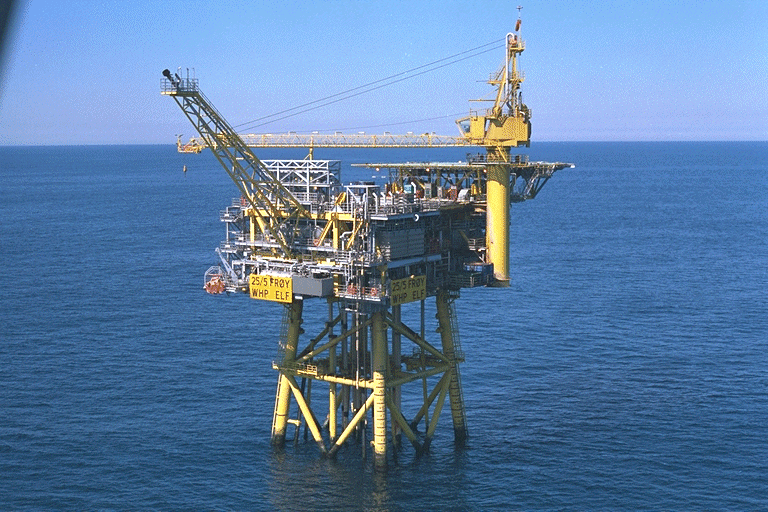
Det norske Delays Froy Field Development

Det norske Delays Froy Field Development

Friday, April 01, 2011
Det norske oljeselskap ASA

As a result of the decision made by Det norske, a plan for development and operations (PDO) for the Froy field will not be filed this year, and it has not been decided when such a plan will be submitted.
Froy Platform
Froy Platform

The plan was to submit a PDO in the autumn 2010 with a FPSO concept. However, this was delayed in order to evaluate the possibility of using simultaneous water and gas injection, rather than water injection only as a production strategy. The results from these studies indicated that SWAG only had a marginal impact on project economics.

The Froy field development, where the partnership already in January 2008 decided to push forward with the project, has been delayed several times. These delays have opened new development alternatives, which Det norske finds prudent to explore.

COO Oyvind Bratsberg said that the company has major field developments ahead as an operator, "Det norske will over the coming years develop from a pure exploration company into a exploration, field development and production company. Going forward the company will concentrate its resources on the Draupne field development and smaller developments, such as Jetta. Froy will be developed at a later stage, and possibly with a different development solution."

Froy holds about 60 million barrels of recoverable oil. Det norske is operator for Froy and holds 50 percent. Premier Oil Norge is the only partner in the license with 50 percent.

Monday, March 28, 2011

Marcellus Impact Fee Proposal In The Works

Marcellus Impact Fee Proposal In The Works


Monday, March 28, 2011
Knight Ridder/Tribune Business News

Friday, March 25, 2011

Ithaca Briefs Impact of UK's Fiscal Changes

Ithaca Briefs Impact of UK's Fiscal Changes


Friday, March 25, 2011
Ithaca Energy Inc.

Ithaca clarifies the impact on the Company's near to medium term financial position further to the recent announcement made by the UK government regarding changes to fiscal regulations.

On March 23, 2011, the UK government announced that it would be increasing the rate of supplementary charge from 20% to 32% from 24 March 2011, resulting in a 62% marginal tax rate. The following important factors should be taken into account when considering the specific impact of the tax increase on the Company:
  • The Company's tax losses pool at the start of 2011 was approximately US $215 million. This pool, combined with the Company's predicted future capital expenditure program, indicates no taxes are likely to be payable for at least the next five years.
  • The Company's revenues from future field developments with approximately less than 25 million barrels of oil equivalent, such as the Athena field, will continue to benefit from the Small Field Allowance sheltering up to US $120 million of field profits from the 32% supplementary charge.
  • The Company has limited decommissioning liabilities, which minimizes its exposure to the announced differential tax treatment of decommissioning costs.
The Company is continuing with its development of the Athena field and the core Stella hub. A review of the Company's portfolio of existing appraisal and development opportunities will be conducted as details of the draft tax change legislation emerge.